Essay
Form And Pressure
FORM AND PRESSURE
ESSAY
STEPHEN SHORE
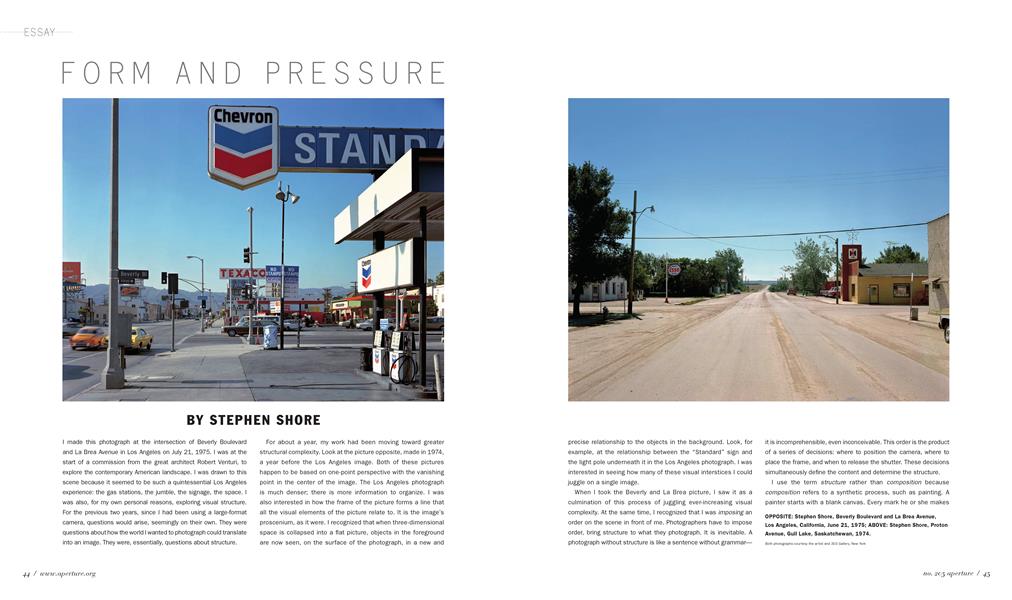
I made this photograph at the intersection of Beverly Boulevard and La Brea Avenue in Los Angeles on July 21, 1975. I was at the start of a commission from the great architect Robert Venturi, to explore the contemporary American landscape. I was drawn to this scene because it seemed to be such a quintessential Los Angeles experience: the gas stations, the jumble, the signage, the space. I was also, for my own personal reasons, exploring visual structure. For the previous two years, since I had been using a large-format camera, questions would arise, seemingly on their own. They were questions about how the world I wanted to photograph could translate into an image. They were, essentially, questions about structure.
For about a year, my work had been moving toward greater structural complexity. Look at the picture opposite, made in 1974, a year before the Los Angeles image. Both of these pictures happen to be based on one-point perspective with the vanishing point in the center of the image. The Los Angeles photograph is much denser; there is more information to organize. I was also interested in how the frame of the picture forms a line that all the visual elements of the picture relate to. It is the image’s proscenium, as it were. I recognized that when three-dimensional space is collapsed into a flat picture, objects in the foreground are now seen, on the surface of the photograph, in a new and precise relationship to the objects in the background. Look, for example, at the relationship between the “Standard” sign and the light pole underneath it in the Los Angeles photograph. I was interested in seeing how many of these visual interstices I could juggle on a single image.
When I took the Beverly and La Brea picture, I saw it as a culmination of this process of juggling ever-increasing visual complexity. At the same time, I recognized that I was imposing an order on the scene in front of me. Photographers have to impose order, bring structure to what they photograph. It is inevitable. A photograph without structure is like a sentence without grammar— it is incomprehensible, even inconceivable. This order is the product of a series of decisions: where to position the camera, where to place the frame, and when to release the shutter. These decisions simultaneously define the content and determine the structure.
I use the term structure rather than composition because composition refers to a synthetic process, such as painting. A painter starts with a blank canvas. Every mark he or she makes adds complexity. A photographer, on the other hand, starts with the whole world. Every decision he or she makes brings order. Composition comes from a Latin root, componere, “to put together.” (Synthesis comes from a Greek root, syntithenai, which also means “to put together.”) A photographer doesn’t “put together” an image; a photographer selects.
Think about the relationship of the world to the observer in an analytic interaction—for example, an astronomer trying to grasp planetary motion. In 1595 Johannes Kepler, at the time a follower of Copernicus, had an epiphany about the organization of the heliocentric universe: that each planet follows a circular orbit— the circle being a perfect form—and each orbit is described by a Platonic solid, one nesting inside the other. This complex idea was rendered in the illustration at left, published in Kepler’s 1596 Mysterium Cosmographicum.
By 1605 Kepler, having worked with the Danish astronomer Tycho Brahe, and having had access to Brahe’s more exact calculations of planetary motion, realized that the orbits could not possibly be circular, but had to be elliptical. Reality did not fit into Kepler’s previous, idealized preconceptions. So he discarded his circular model and replaced it with an elliptical one. Structure brings order to our perceptions. It can clarify them but also impose our preconceptions on them. There are times when our preconceptions butt heads with reality.
Some artists have attempted to find a mode of expression that is less mediated by the visual conventions of their predecessors. This goal is a horizon that keeps receding. For example, the Impressionists broke from the historical, classical, or religious content of academic painting and found a technique that acknowledged the application of paint on the canvas. In doing so they developed their own language with their own conventions.
These two paintings were made in the early 1880s by Claude Monet (opposite, top) and Paul Signac (this page). The Signac is of almost nothing: an empty lot, a factory in the distance, scraggly trees. It is at once random and balanced. It seems photographic in the way the tree on the right is cut off by the frame and in the way that tree’s shadow is treated with the same attention as any object in the picture. But what is most impressive is that it looks like real life. It is not trying to be beautiful. It apparently has not been filtered by a refined sensibility. Even as the Impressionists broke with the visual conventions of the academic painting of their day, so Signac in this one picture transcends the conventions that even the radical Impressionists imposed.
In Hamlet, Shakespeare has the young prince give an acting lesson to the group of players he has brought to Elsinore. Flamlet tells them:
Suit the action to the word, and the word to the action; with this special observance, that you o’erstep not the modesty of nature; for anything so overdone is from the purpose of playing, whose end, both at the first and now, was and is, to hold, as 'twere, the mirror up to nature; to show virtue her own feature, scorn her own image, and the very age and body of the time his form and pressure.
At first Flamlet defines the relationship of form and content (or “action” and “word”). Form—structure—is not an aesthetic nicety applied to content. It is not art sauce poured on top of content. It’s an expression of understanding. But, Hamlet reminds us, “o’erstep not the modesty of nature.” This is a plea for the structure not to call attention to itself, but to be seen through, to be transparent. He then goes on to suggest the scope of the content. Now, theater and literature and film may be better at exploring “virtue” and “scorn” than photography, but then there is this final line: “[To show] the very age and body of the time his form and pressure.” This is within the realm of photography. A photograph can aspire to this.
When I was making the photograph at Beverly and La Brea, as I was figuring out where precisely to position my camera to make sense of all of the visual relationships I was trying to coordinate, I realized that while I was grappling with the visual facts in front of me, I was imposing a truly classical pictorial organization upon them. It brought to my mind the landscapes of Claude Lorrain (whose life overlapped Kepler’s), which often have one-point perspective and include vertical objects near the sides to give tension to the edges and activate the illusion of space.
This troubled me. I was imposing a seventeenth-century solution to a twentieth-century problem. It was an elegant formal solution, but it didn’t express the form and pressure of this age. Like Kepler realizing that his assumptions did not account for the facts, or like Signac recognizing the visual conventions of his day, I was aware that I was imposing an organization that came from me and from what I had learned; it was not really an outgrowth of the scene in front of me. With this in mind, the next day I went back to the same intersection and made the photograph on the facing page.
As I approached the intersection for a second time, I asked myself if I could organize the information I wanted to include without relying on an overriding structural principle, as I’d done the day before. Could I structure the picture in a way that communicated my experience of standing there, taking in the scene in front of me? Sometimes I have the sense that form contains an almost philosophical communication—that as form becomes more invisible, transparent, it begins to express an artist’s understanding of the structure of experience.
One of the most eloquent descriptions of the deep interaction between form and content was written in the fourteenth century by the Persian poet Mahmud Shabistari:
The speck of dust that sparkles in a beam of light is nothing by itself, but by external cause obtains existence and apparent form: but as without the dust no form appears, so without the form neither does the dust exist.
Like a speck of dust in a beam of light: you cannot see the dust without the light, nor can you see the light without the dust; you can’t see content without form, nor can you see form without content.©
More From This Issue
-
 Dialogue
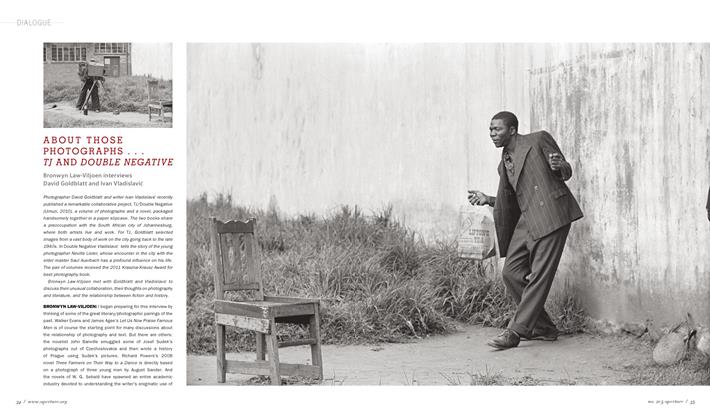
About Those Photographs... Tj And Double Negative
Winter 2011 -
 Witness
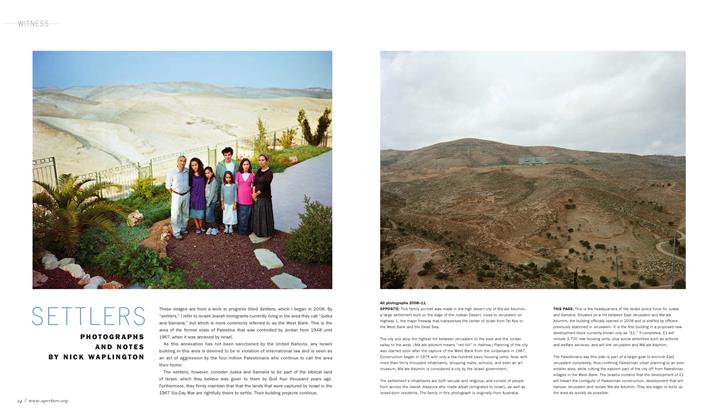
Settlers
Winter 2011 -
 Roads Less Traveled
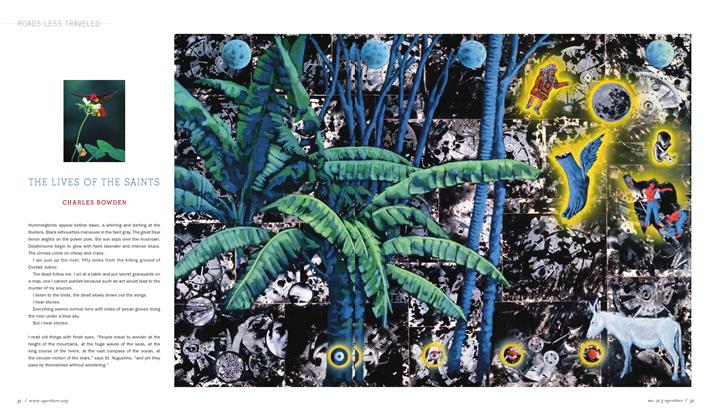
The Lives Of The Saints
Winter 2011 -
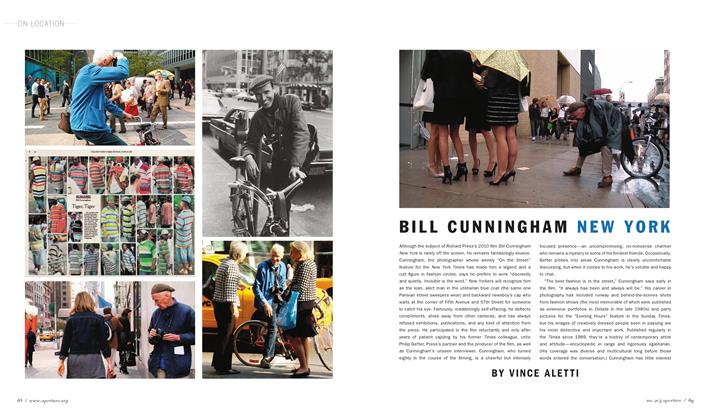 On Location
Bill Cunningham: New York
Winter 2011 -
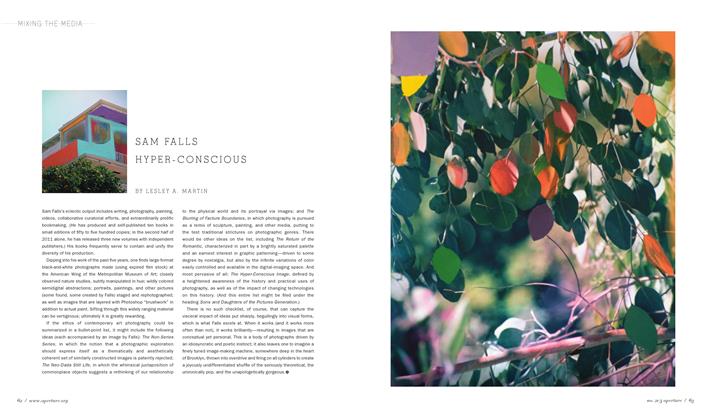 Mixing The Media
Sam Falls Hyper-Conscious
Winter 2011 -
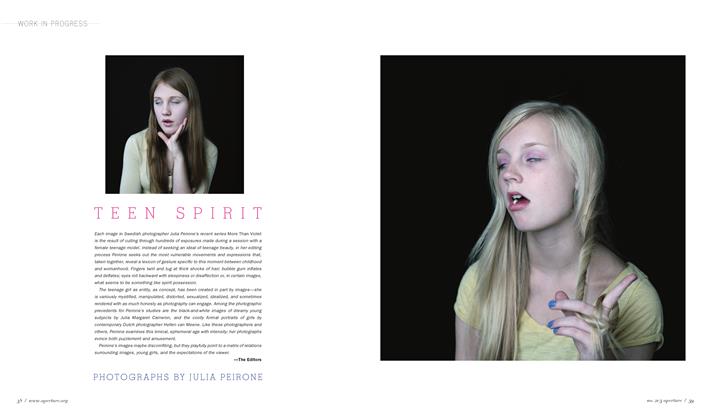 Work In Progress
Teen Spirit
Winter 2011