Notebook
A legendary photographer rediscovers one of his first pictures —and finds a world of its own.
Notebook
A legendary photographer rediscovers one of his first pictures —and finds a world of its own.
Stephen Shore
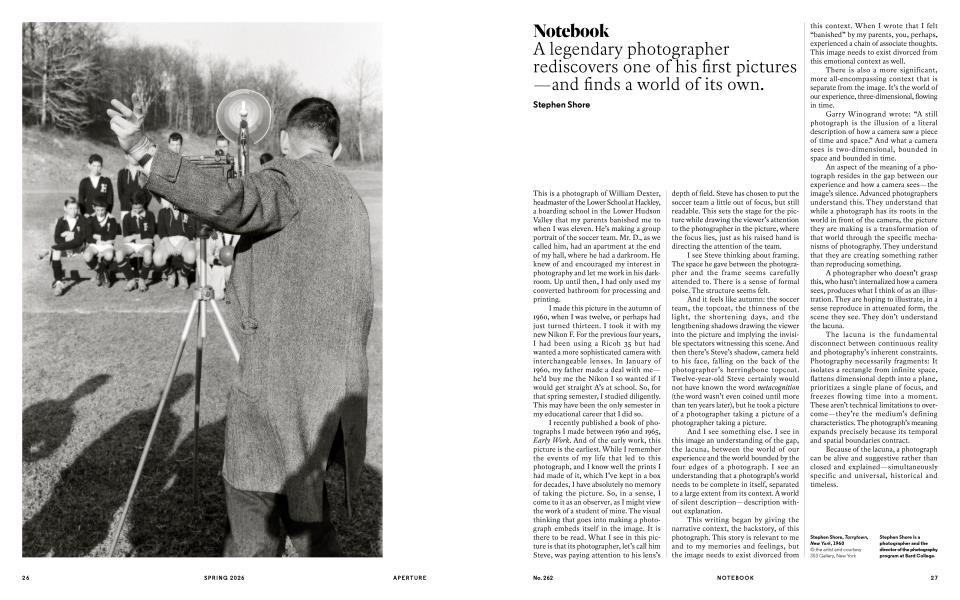
This is a photograph of William Dexter, headmaster of the Lower School at Hackley, a boarding school in the Lower Hudson Valley that my parents banished me to when I was eleven. He’s making a group portrait of the soccer team. Mr. D., as we called him, had an apartment at the end of my hall, where he had a darkroom. He knew of and encouraged my interest in photography and let me work in his darkroom. Up until then, I had only used my converted bathroom for processing and printing.
I made this picture in the autumn of i960, when I was twelve, or perhaps had just turned thirteen. I took it with my new Nikon F. For the previous four years, I had been using a Ricoh 35 but had wanted a more sophisticated camera with interchangeable lenses. In January of i960, my father made a deal with me— he’d buy me the Nikon I so wanted if I would get straight A’s at school. So, for that spring semester, I studied diligently. This may have been the only semester in my educational career that I did so.
I recently published a book of photographs I made between i960 and 1965, Early Work. And of the early work, this picture is the earliest. While I remember the events of my life that led to this photograph, and I know well the prints I had made of it, which I’ve kept in a box for decades, I have absolutely no memory of taking the picture. So, in a sense, I come to it as an observer, as I might view the work of a student of mine. The visual thinking that goes into making a photograph embeds itself in the image. It is there to be read. What I see in this picture is that its photographer, let’s call him Steve, was paying attention to his lens’s depth of field. Steve has chosen to put the soccer team a little out of focus, but still readable. This sets the stage for the picture while drawing the viewer’s attention to the photographer in the picture, where the focus lies, just as his raised hand is directing the attention of the team.
I see Steve thinking about framing. The space he gave between the photographer and the frame seems carefully attended to. There is a sense of formal poise. The structure seems felt.
And it feels like autumn: the soccer team, the topcoat, the thinness of the light, the shortening days, and the lengthening shadows drawing the viewer into the picture and implying the invisible spectators witnessing this scene. And then there’s Steve’s shadow, camera held to his face, falling on the back of the photographer’s herringbone topcoat. Twelve-year-old Steve certainly would not have known the word metacognition (the word wasn’t even coined until more than ten years later), but he took a picture of a photographer taking a picture of a photographer taking a picture.
And I see something else. I see in this image an understanding of the gap, the lacuna, between the world of our experience and the world bounded by the four edges of a photograph. I see an understanding that a photograph’s world needs to be complete in itself, separated to a large extent from its context. A world of silent description—description without explanation.
This writing began by giving the narrative context, the backstory, of this photograph. This story is relevant to me and to my memories and feelings, but the image needs to exist divorced from this context. When I wrote that I felt “banished” by my parents, you, perhaps, experienced a chain of associate thoughts. This image needs to exist divorced from this emotional context as well.
There is also a more significant, more all-encompassing context that is separate from the image. It’s the world of our experience, three-dimensional, flowing in time.
Garry Winogrand wrote: “A still photograph is the illusion of a literal description of how a camera saw a piece of time and space.” And what a camera sees is two-dimensional, bounded in space and bounded in time.
An aspect of the meaning of a photograph resides in the gap between our experience and how a camera sees—the image’s silence. Advanced photographers understand this. They understand that while a photograph has its roots in the world in front of the camera, the picture they are making is a transformation of that world through the specific mechanisms of photography. They understand that they are creating something rather than reproducing something.
A photographer who doesn’t grasp this, who hasn’t internalized how a camera sees, produces what I think of as an illustration. They are hoping to illustrate, in a sense reproduce in attenuated form, the scene they see. They don’t understand the lacuna.
The lacuna is the fundamental disconnect between continuous reality and photography’s inherent constraints. Photography necessarily fragments: It isolates a rectangle from infinite space, flattens dimensional depth into a plane, prioritizes a single plane of focus, and freezes flowing time into a moment. These aren’t technical limitations to overcome—they’re the medium’s defining characteristics. The photograph’s meaning expands precisely because its temporal and spatial boundaries contract.
Because of the lacuna, a photograph can be alive and suggestive rather than closed and explained—simultaneously specific and universal, historical and timeless.
Stephen Shore is a photographer and the director of the photography program at Bard College.