Words
Allan Sekula: Aerospace Folktales
Allan Sekula
Aerospace Folktales
Drew Sawyer
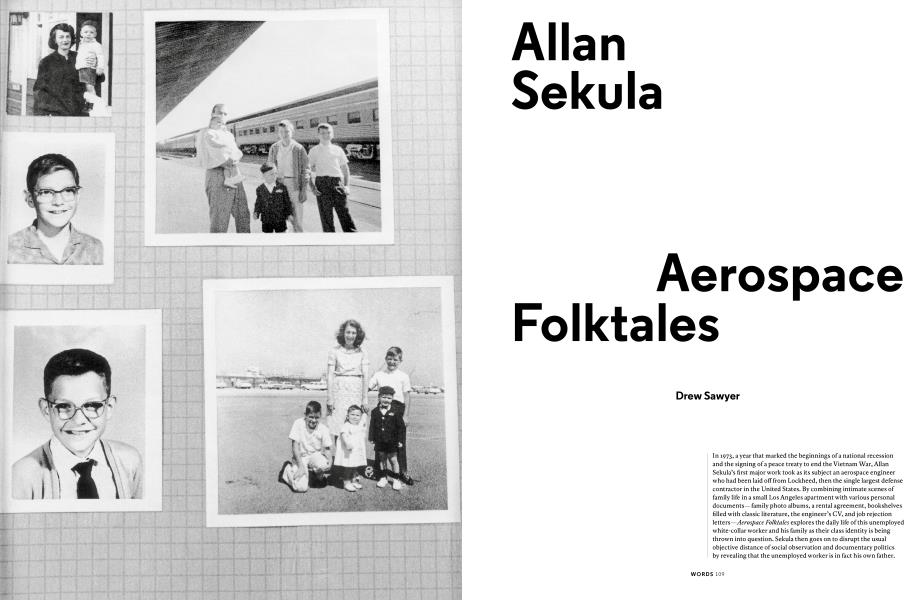
In 1973, a year that marked the beginnings of a national recession and the signing of a peace treaty to end the Vietnam War, Allan Sekula’s first major work took as its subject an aerospace engineer who had been laid off from Lockheed, then the single largest defense contractor in the United States. By combining intimate scenes of family life in a small Los Angeles apartment with various personal documents—family photo albums, a rental agreement, bookshelves filled with classic literature, the engineer’s CV, and job rejection letters—Aerospace Folktales explores the daily life of this unemployed white-collar worker and his family as their class identity is being thrown into question. Sekula then goes on to disrupt the usual objective distance of social observation and documentary politics by revealing that the unemployed worker is in fact his own father. The result is a group portrait of an artist and his family in relation to each other and to their surrounding social and economic structures.
At its peak, in 1967, Southern California’s vast aerospace industry accounted for nearly half a million jobs. But the waning of the Vietnam War and of the Apollo space program, along with a recession, brought a sharp falloff in military and NASA procurements that resulted in a succession of layoffs during the early 1970s. Many of those employees were, like Sekula’s father, professionals and experts who had risen to the middle class after World War II by obtaining undergraduate and graduate degrees. Sekula forces both his subjects and viewers to consider the dissolution of the postwar American dream, and the artist himself wonders in an accompanying text what will become of his career as an “art engineer” once he completes his graduate degree.
In its original installation at the University of California, San Diego (UCSD), in 1973, Aerospace Folktales consisted of 142 black-and-white photographic images and text cards, along with four sound recordings of interviews between the artist and his father, his mother, and his mother’s friend (whose husband was also unemployed). Sekula hung the 142 photographs in a single row with text cards breaking the sequence into smaller groups that suggested the narrative flow and format of a silent movie. In this first exhibition, the audio played in an adjacent room, but in a 1974 installation at the Brand Library & Art Center in Glendale, near the Lockheed plant, the speakers were hidden behind potted plants in the gallery. At UCSD, Sekula performed a reading of an explanatory text, typed on seven pages of letter-size paper and titled “a commentary,” serving as a general narration but also “filling in for earlier omissions ... because of the limited representational range of the camera.” In 1984, the year he published his seminal book Photography Against the Grain, Sekula edited the work down to fifty-one photographs, often grouped as diptychs or in grids of four, and three sound recordings.
Sekula referred to the work, with its deconstruction of the essential elements of a film, as a “disassembled movie.” He had already begun to experiment with this format in his 35mm slide show Untitled Slide Sequence from 1972. Here too he turned his camera on aerospace factory workers, but without the typical veneration associated with pictures of such laborers taken by photographers for the Office of War Information or popular magazines like Fortune during the 1940s. Instead, he chose to capture the workers just as they were leaving their shifts at a General Dynamics Convair Division factory in San Diego, where several of them likely helped produce the F-111 military planes that flew in Vietnam. The twenty-five images in this sequence depict a range of employees as they climb the staircase to a pedestrian overpass and are directly confronted by the artist’s camera. Sekula had originally envisioned Aerospace Folktales as a slide show as well, but ultimately decided to keep separate image, text, and audio “tracks,” allowing their formal discontinuities to underscore the contradictions inherent in the documentary genre as well as in contemporary life—both are their own kinds of folktales or mythologies.
Like a film, Aerospace Folktales begins not with an image, but with text. Included is a short excerpt from Lockheed’s promotional materials, with typical corporate platitudes, and a quote from the company’s chairman that declares: “Our competence has kept us in the forefront of the industry... I know that at Lockheed our eyes are on the future, and our efforts are in a large part directed toward realizing it fully.” Several reproductions of archival newspaper photographs follow of what seem to be cheerful Lockheed employees and U.S. military personnel standing in a parking lot. Next appears a suite of straight photographs of Lockheed’s Burbank plant and parking lot, where Sekula’s father and a friend stand next to a Ford station wagon. The change from the archival halftone images to the documentary photographs conveys a movement forward in time, but the nearly empty parking lot and the uneasy engineer suggest the future is not quite what Lockheed had promised.
More often, though, Sekula takes viewers into the family’s apartment in San Pedro, a working-class neighborhood in which the Port of Los Angeles is partially located. There, we witness the father’s attempts to fill his days and evenings by reading the newspaper, writing letters, and fixing a lamp while Sekula’s younger siblings do schoolwork and play. Sekula referred to these banal everyday activities as his parents’ “white-collar art”—the patterns of thought and behavior that formed their worldviews and identities. Both his mother’s and father’s own words, heard in the interviews, reflect the frustrations of finding employment at middle age and their conflicting ideas about technology, the economy, and the future of the country. Why did his father, Sekula wondered in his commentary, mimic the rhetoric of Lockheed’s upper management, when those beliefs went against his own economic and political interests? As the sequences and sound track progress, the focus shifts from father to mother, as she prepares dinner and arranges flowers in a vase. “Her unpaid labor,” Sekula explains, “provides management with well-fed, well-cared-for labor, forty hours a week,” an attentiveness to the gendered dimension of labor that places his work in dialogue with the feminist movement and related art practices of the decade.
While an MFA student at the University of California, San Diego, a school founded in i960 with the support of the military and aerospace industries already located nearby, Sekula became close with the artist Martha Rosier, known for photomontages and videos that impugn traditional gender roles. Studying art with David Antin and John Baldessari, and Marxist philosophy with Herbert Marcuse and Fredric Jameson, Sekula and Rosier, along with fellow classmates Fred Lonidier and Phel Steinmetz, utilized the strategies of Conceptual art and institutional critique to both challenge the orthodoxies of modernism and reestablish a political documentary artistic practice. In the 1970s, Sekula would publish a series of seminal essays, including “Dismantling Modernism, Reinventing Documentary (Notes on the Politics of Representation)” (1976-78), which questions the separation of art from everyday life and politics, the aestheticization of suffering and poverty, and the myth of photographic truth and neutrality. It became a manifesto for both his generation of artists and those to follow.
Over the course of Sekula’s practice, his writings grew inextricably tied to his art, as he refused to concede the usual divisions between artist, critic, and historian. A deep appreciation and understanding of the histories of photography are reflected throughout his work. While Untitled Slide Sequence is in part a tribute to the Lumiere brothers’ first film, Workers Leaving the Lumiere Factory (1895), Aerospace Folktales pays homage to Walker Evans and James Agee’s 1941 experimental documentary book, Let Us Now Praise Famous Men. That book, which began as a picture story for Fortune magazine in 1936, documents the families of tenant cotton farmers in Alabama during the Great Depression and similarly separates the constitutive elements of documentary—image and text. Sekula’s sequence of photographs of his parents standing against a slatted garage door outside their apartment building is perhaps the most obvious reference to Evans’s iconic portraits of farmers against their clapboard shacks, and stakes a claim to a lineage of challenging, if not radical, forms of documentary from the first half of the twentieth century.
While Sekula remained based in Los Angeles for much of his working life (he died in 2013), teaching photography and critical theory at the California Institute of the Arts, his art would eventually take him to far-flung places, as his attention shifted to the accumulating effects of global capitalism. His photobook and multipart exhibition Fish Story (1989-95), along with his and Noel Burch’s film The Forgotten Space (2010), track maritime space and the impact of the invention of the cargo container, or what Sekula called “the very coffin of remote labor power.” For the artist, large seaports, like the one just down the street from his family’s home in San Pedro, had remained relatively invisible, located on the outskirts of large metropolitan centers. Yet, they had radically changed manufacturing and the distribution of both goods and labor. “Factories are now like ships: they mutate strangely, masquerade, and sometimes sail away stealthily in the night in search of cheaper labor, leaving their former employees bewildered and jobless,” he lamented. Sekula’s art was about making visible those unseen, or at least undocumented, aspects of our economy. This was never an easy task, neither for the artist nor the viewer—photography was not merely a product, but always a process of labor.
Drew Sawyer is the William J. and Sarah Ross Soter Associate Curator of Photography at the Columbus Museum of Art, where he is organizing an exhibition on the original version of Aerospace Folktales, along with other slide and video works by Allan Sekula.