Eamonn Doyle:i
Eamonn Doyle:i
Brian Dillon
They are everywhere in the writings of Samuel Beckett, these ancient, hunched figures on the point of collapse—looking as if they will snap or fold in two. They huddle inside filthy dens in his fictional trilogy (Molloy, 1951; Malone Dies, 1951; The Unnamable, 1953). They waddle slantwise on country roads in Watt (1953). In the plays they stand statue-still (Catastrophe, 1982), curl up, and keen away their lives (Rockaby, 1981), or shuffle facelessly around in geometric relays, as in the late television play Quad (1981). Beckett divined early on the depredations of a creaking and solitary old age, and as Eamonn Doyle’s photographs remind us, he lifted the motif in part from the streets of his native Dublin.
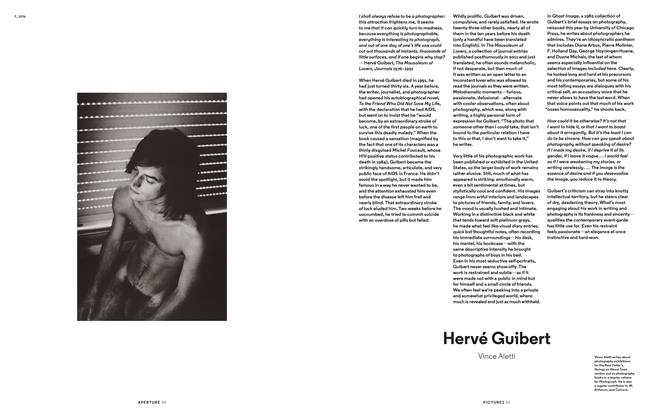
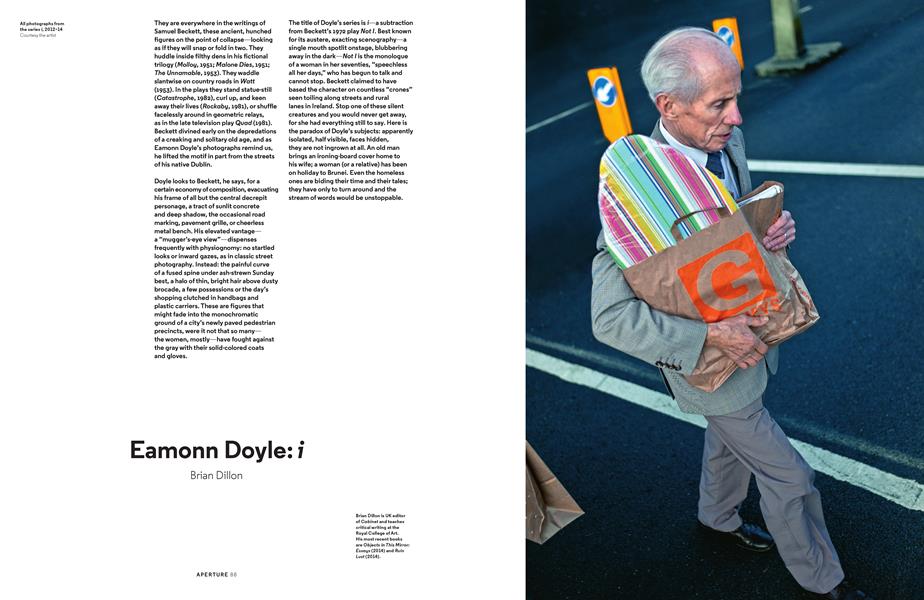
Doyle looks to Beckett, he says, for a certain economy of composition, evacuating his frame of all but the central decrepit personage, a tract of sunlit concrete and deep shadow, the occasional road marking, pavement grille, or cheerless metal bench. His elevated vantage— a “mugger's-eye view”—dispenses frequently with physiognomy: no startled looks or inward gazes, as in classic street photography. Instead: the painful curve of a fused spine under ash-strewn Sunday best, a halo of thin, bright hair above dusty brocade, a few possessions or the day’s shopping clutched in handbags and plastic carriers. These are figures that might fade into the monochromatic ground of a city’s newly paved pedestrian precincts, were it not that so many— the women, mostly—have fought against the gray with their solid-colored coats and gloves.
The title of Doyle's series is i—a subtraction from Beckett’s 1972 play Not I. Best known for its austere, exacting scenography—a single mouth spotlit onstage, blubbering away in the dark—Not I is the monologue of a woman in her seventies, “speechless all her days,” who has begun to talk and cannot stop. Beckett claimed to have based the character on countless “crones” seen toiling along streets and rural lanes in Ireland. Stop one of these silent creatures and you would never get away, for she had everything still to say. Here is the paradox of Doyle’s subjects: apparently isolated, half visible, faces hidden, they are not ingrown at all. An old man brings an ironing-board cover home to his wife; a woman (or a relative) has been on holiday to Brunei. Even the homeless ones are biding their time and their tales; they have only to turn around and the stream of words would be unstoppable.
Brian Dillon is UK editor of Cabinet and teaches critical writing at the Royal College of Art. His most recent books are Objects in This Mirror: Essays (2014) and Ruin lust (2014).