People And Ideas
Men's Lives
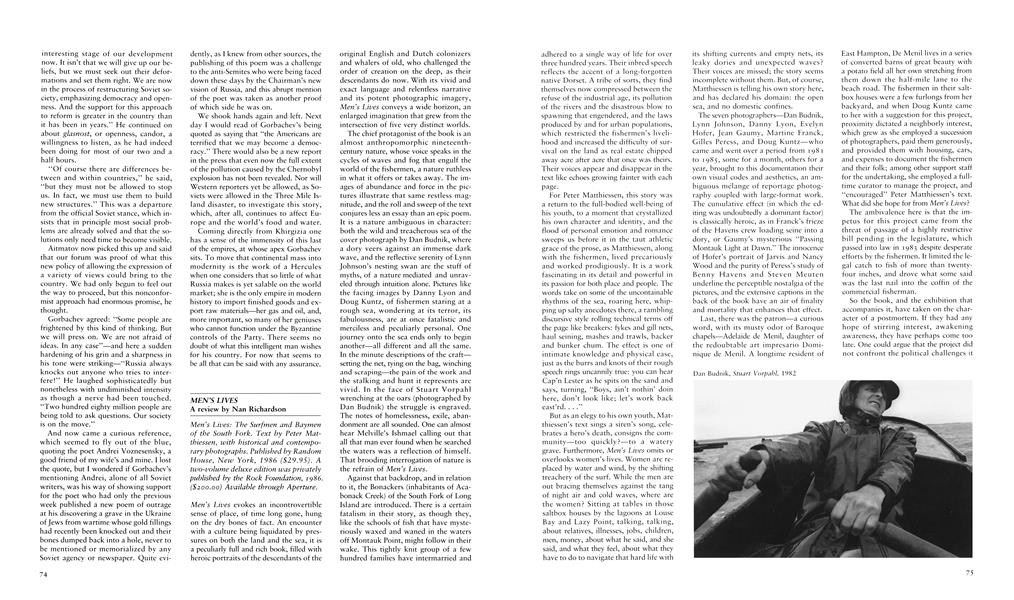
MEN'S LIVES
Nan Richardson
Men's Lives: The Surfmen and Baymen of the South Fork. Text by Peter Matthiessen, with historical and contemporary photographs. Published by Random House, New York, 1986 ($29.95). A two-volume deluxe edition was privately published by the Rock Foundation, 1986. ($200.00) Available through Aperture.
Men's Lives evokes an incontrovertible sense of place, of time long gone, hung on the dry bones of fact. An encounter with a culture being liquidated by pressures on both the land and the sea, it is a peculiarly full and rich book, filled with heroic portraits of the descendants of the original English and Dutch colonizers and whalers of old, who challenged the order of creation on the deep, as their descendants do now. With its vivid and exact language and relentless narrative and its potent photographic imagery, Men's Lives conveys a wide horizon, an enlarged imagination that grew from the intersection of five very distinct worlds.
The chief protagonist of the book is an almost anthropomorphic nineteenthcentury nature, whose voice speaks in the cycles of waves and fog that engulf the world of the fishermen, a nature ruthless in what it offers or takes away. The images of abundance and force in the pictures illustrate that same restless magnitude, and the roll and sweep of the text conjures less an essay than an epic poem. It is a nature ambiguous in character: both the wild and treacherous sea of the cover photograph by Dan Budnik, where a dory veers against an immense dark wave, and the reflective serenity of Lynn Johnson’s nesting swan are the stuff of myths, of a nature mediated and unraveled through intuition alone. Pictures like the facing images by Danny Lyon and Doug Kuntz, of fishermen staring at a rough sea, wondering at its terror, its fabulousness, are at once fatalistic and merciless and peculiarly personal. One journey onto the sea ends only to begin another—all different and all the same. In the minute descriptions of the craft— setting the net, tying on the bag, winching and scraping—the pain of the work and the stalking and hunt it represents are vivid. In the face of Stuart Vorpahl wrenching at the oars (photographed by Dan Budnik) the struggle is engraved. The notes of homelessness, exile, abandonment are all sounded. One can almost hear Melville’s Ishmael calling out that all that man ever found when he searched the waters was a reflection of himself. That brooding interrogation of nature is the refrain of Men's Lives.
Against that backdrop, and in relation to it, the Bonackers (inhabitants of Acabonack Creek) of the South Fork of Long Island are introduced. There is a certain fatalism in their story, as though they, like the schools of fish that have mysteriously waxed and waned in the waters off Montauk Point, might follow in their wake. This tightly knit group of a few hundred families have intermarried and adhered to a single way of life for over three hundred years. Their inbred speech reflects the accent of a long-forgotten native Dorset. A tribe of sorts, they find themselves now compressed between the refuse of the industrial age, its pollution of the rivers and the disastrous blow to spawning that engendered, and the laws produced by and for urban populations, which restricted the fishermen’s livelihood and increased the difficulty of survival on the land as real estate chipped away acre after acre that once was theirs. Their voices appear and disappear in the text like echoes growing fainter with each page.
For Peter Matthiessen, this story was a return to the full-bodied well-being of his youth, to a moment that crystallized his own character and identity, and the flood of personal emotion and romance sweeps us before it in the taut athletic grace of the prose, as Matthiessen, along with the fishermen, lived precariously and worked prodigiously. It is a work fascinating in its detail and powerful in its passion for both place and people. The words take on some of the uncontainable rhythms of the sea, roaring here, whipping up salty anecdotes there, a rambling discursive style rolling technical terms off the page like breakers: fykes and gill nets, haul seining, mashes and trawls, backer and bunker chum. The effect is one of intimate knowledge and physical ease, just as the burrs and knots of their rough speech rings uncannily true: you can hear Cap’n Lester as he spits on the sand and says, turning, “Boys, ain’t nothin’ doin here, don’t look like; let’s work back east’rd. . . .”
But as an elegy to his own youth, Matthiessen’s text sings a siren’s song, celebrates a hero’s death, consigns the community—too quickly?—to a watery grave. Furthermore, Men’s Lives omits or overlooks women’s lives. Women are replaced by water and wind, by the shifting treachery of the surf. While the men are out bracing themselves against the tang of night air and cold waves, where are the women? Sitting at tables in those saltbox houses by the lagoons at Louse Bay and Lazy Point, talking, talking, about relatives, illnesses, jobs, children, men, money, about what he said, and she said, and what they feel, about what they have to do to navigate that hard life with its shifting currents and empty nets, its leaky dories and unexpected waves? Their voices are missed; the story seems incomplete without them. But, of course, Matthiessen is telling his own story here, and has declared his domain: the open sea, and no domestic confines.
The seven photographers—Dan Budnik, Lynn Johnson, Danny Lyon, Evelyn Hofer, Jean Gaumy, Martine Franck, Gilles Peress, and Doug Kuntz—who came and went over a period from 1981 to 1985, some for a month, others for a year, brought to this documentation their own visual codes and aesthetics, an ambiguous mélange of reportage photography coupled with large-format work. The cumulative effect (in which the editing was undoubtedly a dominant factor) is classically heroic, as in Franck’s frieze of the Havens crew loading seine into a dory, or Gaumy’s mysterious “Passing Montauk Light at Dawn.” The innocence of Hofer’s portrait of Jarvis and Nancy Wood and the purity of Peress’s study of Benny Havens and Steven Meuten underline the perceptible nostalgia of the pictures, and the extensive captions in the back of the book have an air of finality and mortality that enhances that effect.
Last, there was the patron—a curious word, with its musty odor of Baroque chapels—Adelaide de Menii, daughter of the redoubtable art impresario Dominique de Menii. A longtime resident of East Hampton, De Menii lives in a series of converted barns of great beauty with a potato field all her own stretching from them down the half-mile lane to the beach road. The fishermen in their saltbox houses were a few furlongs from her backyard, and when Doug Kuntz came to her with a suggestion for this project, proximity dictated a neighborly interest, which grew as she employed a succession of photographers, paid them generously, and provided them with housing, cars, and expenses to document the fishermen and their folk; among other support staff for the undertaking, she employed a fulltime curator to manage the project, and “encouraged” Peter Matthiessen’s text. What did she hope for from Men’s Lives?
The ambivalence here is that the impetus for this project came from the threat of passage of a highly restrictive bill pending in the legislature, which passed into law in 1983 despite desperate efforts by the fishermen. It limited the legal catch to fish of more than twentyfour inches, and drove what some said was the last nail into the coffin of the commercial fisherman.
So the book, and the exhibition that accompanies it, have taken on the character of a postmortem. If they had any hope of stirring interest, awakening awareness, they have perhaps come too late. One could argue that the project did not confront the political challenges it was meant to face; while it succeeds at preserving the memory of those men’s lives, it fails to create energy for the future of their children. Nor does it really explain what is their immediate future now that the bill has been passed; it buries Captain Havens with the clear implication that the others will follow him into extinction.
That said, one must further ask whom this book is for. Both the trade edition, handsomely reproduced, with single-tone historical photographs, charming line drawings of some of the four hundred species of fish that frequent Montauk waters, and duotone plates on heavyweight glossy paper, and the two-volume, slip-cased deluxe edition, seem destined for the bookshelves and coffee tables of the new residents who displaced the Bonackers, the city people who occupy those big houses by the Hampton beaches, who would value the reminder of the fishermen’s existence for the piquant authenticity it adds to the area.
It is that sense of unease, subtly, intangibly patronizing, confusing itself with the cause of social reform, that makes Men’s Lives uncomfortably like the Walter Scott epigraph at the front of the book, “It’s not fish ye’re buyin, it’s men’s lives.”

More From This Issue
-
Sebastião Salgado: Man In Distress
Fall 1987 -
David Goldblatt: Home Land
Fall 1987 -
Susan Meiselas: The Frailty Of The Frame, Work In Progress
Fall 1987 -
 People And Ideas
Issyk-Kul: A Conversation With Gorbachev
Fall 1987 -
 People And Ideas
Life’s Lingering Shadow
Fall 1987 -
 Editor's Note
Witness To Crisis
Fall 1987
Nan Richardson
People And Ideas
-
 People And Ideas
Aaron Siskind, 1903-1991
Spring 1991 -
 People And Ideas
Rereading The Past
Winter 1996 -
 People And Ideas
On Our Own
Fall 1990 -
 People And Ideas
Christenberry’s Southern Discomfort
Fall 1996 -
 People And Ideas
A One-Woman Show: An Interview With Marie Yolande St. Fleur
Winter 1992 -
 People And Ideas
White Darkness/black Dreamings
Winter 1992


