People And Ideas
Life’s Lingering Shadow
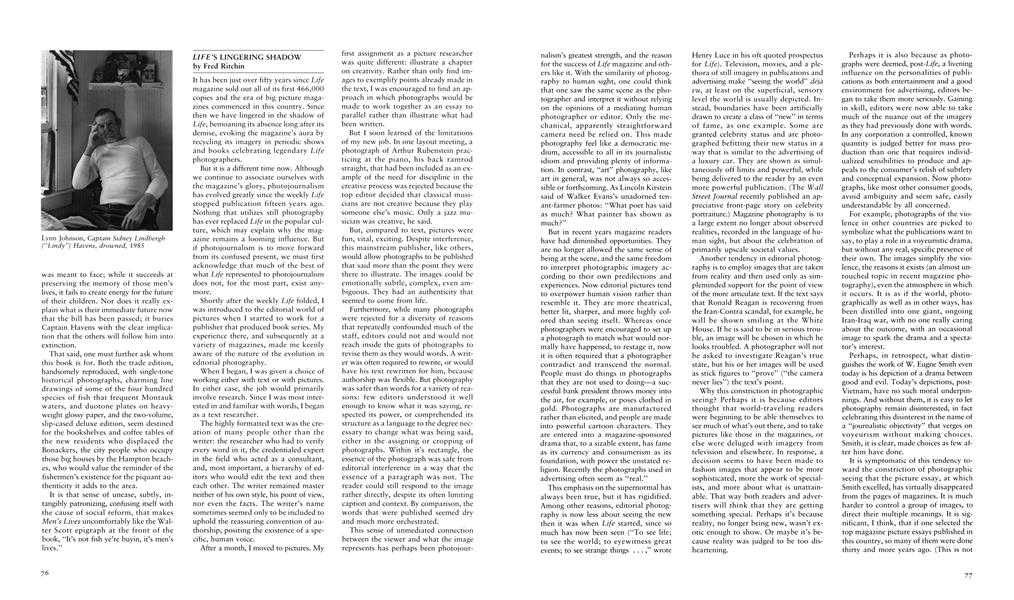
LIFE’S LINGERING SHADOW
Fred Ritchin
It has been just over fifty years since Life magazine sold out all of its first 466,000 copies and the era of big picture magazines commenced in this country. Since then we have lingered in the shadow of Life, bemoaning its absence long after its demise, evoking the magazine's aura by recycling its imagery in periodic shows and books celebrating legendary Life photographers.
But it is a different time now. Although we continue to associate ourselves with the magazine’s glory, photojournalism has evolved greatly since the weekly Life stopped publication fifteen years ago. Nothing that utilizes still photography has ever replaced Life in the popular culture, which may explain why the magazine remains a looming influence. But if photojournalism is to move forward from its confused present, we must first acknowledge that much of the best of what Life represented to photojournalism does not, for the most part, exist anymore.
Shortly after the weekly Life folded, I was introduced to the editorial world of pictures when I started to work for a publisher that produced book series. My experience there, and subsequently at a variety of magazines, made me keenly aware of the nature of the evolution in editorial photography.
When I began, I was given a choice of working either with text or with pictures. In either case, the job would primarily involve research. Since I was most interested in and familiar with words, I began as a text researcher.
The highly formatted text was the creation of many people other than the writer: the researcher who had to verify every word in it, the credentialed expert in the field who acted as a consultant, and, most important, a hierarchy of editors who would edit the text and then each other. The writer remained master neither of his own style, his point of view, nor even the facts. The writer’s name sometimes seemed only to be included to uphold the reassuring convention of authorship, positing the existence of a specific, human voice.
After a month, I moved to pictures. My first assignment as a picture researcher was quite different: illustrate a chapter on creativity. Rather than only find images to exemplify points already made in the text, I was encouraged to find an approach in which photographs would be made to work together as an essay to parallel rather than illustrate what had been written.
But I soon learned of the limitations of my new job. In one layout meeting, a photograph of Arthur Rubenstein practicing at the piano, his back ramrod straight, that had been included as an example of the need for discipline in the creative process was rejected because the top editor decided that classical musicians are not creative because they play someone else’s music. Only a jazz musician was creative, he said.
But, compared to text, pictures were fun, vital, exciting. Despite interference, this mainstream publisher, like others, would allow photographs to be published that said more than the point they were there to illustrate. The images could be emotionally subtle, complex, even ambiguous. They had an authenticity that seemed to come from life.
Furthermore, while many photographs were rejected for a diversity of reasons that repeatedly confounded much of the staff, editors could not and would not reach inside the guts of photographs to revise them as they would words. A writer was often required to rewrite, or would have his text rewritten for him, because authorship was flexible. But photography was safer than words for a variety of reasons: few editors understood it well enough to know what it was saying, respected its power, or comprehended its structure as a language to the degree necessary to change what was being said, either in the assigning or cropping of photographs. Within it’s rectangle, the essence of the photograph was safe from editorial interference in a way that the essence of a paragraph was not. The reader could still respond to the image rather directly, despite its often limiting caption and context. By comparison, the words that were published seemed dry and much more orchestrated.
This sense of unmediated connection between the viewer and what the image represents has perhaps been photojournalism’s greatest strength, and the reason for the success of Life magazine and others like it. With the similarity of photography to human sight, one could think that one saw the same scene as the photographer and interpret it without relying on the opinions of a mediating human photographer or editor. Only the mechanical, apparently straightforward camera need be relied on. This made photography feel like a democratic medium, accessible to all in its journalistic idiom and providing plenty of information. In contrast, “art” photography, like art in general, was not always so accessible or forthcoming. As Lincoln Kirstein said of Walker Evans’s unadorned tenant-farmer photos: “What poet has said as much? What painter has shown as much?”
But in recent years magazine readers have had diminished opportunities. They are no longer allowed the same sense of being at the scene, and the same freedom to interpret photographic imagery according to their own predilections and experiences. Now editorial pictures tend to overpower human vision rather than resemble it. They are more theatrical, better lit, sharper, and more highly colored than seeing itself. Whereas once photographers were encouraged to set up a photograph to match what would normally have happened, to restage it, now it is often required that a photographer contradict and transcend the normal. People must do things in photographs that they are not used to doing—a successful bank president throws money into the air, for example, or poses clothed in gold. Photographs are manufactured rather than elicited, and people are made into powerful cartoon characters. They are entered into a magazine-sponsored drama that, to a sizable extent, has fame as its currency and consumerism as its foundation, with power the unstated religion. Recently the photographs used in advertising often seem as “real.”
This emphasis on the supernormal has always been true, but it has rigidified. Among other reasons, editorial photography is now less about seeing the new then it was when Life started, since so much has now been seen (“To see life; to see the world; to eyewitness great events; to see strange things . . . ,” wrote Henry Luce in his oft quoted prospectus for Life). Television, movies, and a plethora of still imagery in publications and advertising make “seeing the world” déjà vu, at least on the superficial, sensory level the world is usually depicted. Instead, boundaries have been artificially drawn to create a class of “new” in terms of fame, as one example. Some are granted celebrity status and are photographed befitting their new status in a way that is similar to the advertising of a luxury car. They are shown as simultaneously off limits and powerful, while being delivered to the reader by an even more powerful publication. (The Wall Street Journal recently published an appreciative front-page story on celebrity portraiture.) Magazine photography is to a large extent no longer about observed realities, recorded in the language of human sight, but about the celebration of primarily upscale societal values.
Another tendency in editorial photography is to employ images that are taken from reality and then used only as simpleminded support for the point of view of the more articulate text. If the text says that Ronald Reagan is recovering from the Iran-Contra scandal, for example, he will be shown smiling at the White House. If he is said to be in serious trouble, an image will be chosen in which he looks troubled. A photographer will not be asked to investigate Reagan’s true state, but his or her images will be used as stick figures to “prove” (“the camera never lies”) the text’s point.
Why this constriction in photographic seeing? Perhaps it is because editors thought that world-traveling readers were beginning to be able themselves to see much of what’s out there, and to take pictures like those in the magazines, or else were deluged with imagery from television and elsewhere. In response, a decision seems to have been made to fashion images that appear to be more sophisticated, more the work of specialists, and more about what is unattainable. That way both readers and advertisers will think that they are getting something special. Perhaps it’s because reality, no longer being new, wasn’t exotic enough to show. Or maybe it’s because reality was judged to be too disheartening.
Perhaps it is also because as photographs were deemed, post -Life, a livening influence on the personalities of publications as both entertainment and a good environment for advertising, editors began to take them more seriously. Gaining in skill, editors were now able to take much of the nuance out of the imagery as they had previously done with words. In any corporation a controlled, known quantity is judged better for mass production than one that requires individualized sensibilities to produce and appeals to the consumer’s relish of subtlety and conceptual expansion. Now photographs, like most other consumer goods, avoid ambiguity and seem safe, easily understandable by all concerned.
For example, photographs of the violence in other countries are picked to symbolize what the publications want to say, to play a role in a voyeuristic drama, but without any real, specific presence of their own. The images simplify the violence, the reasons it exists (an almost untouched topic in recent magazine photography), even the atmosphere in which it occurs. It is as if the world, photographically as well as in other ways, has been distilled into one giant, ongoing Iran-Iraq war, with no one really caring about the outcome, with an occasional image to spark the drama and a spectator’s interest.
Perhaps, in retrospect, what distinguishes the work of W. Eugne Smith even today is his depiction of a drama between good and evil. Today’s depictions, postVietnam, have no such moral underpinnings. And without them, it is easy to let photography remain disinterested, in fact celebrating this disinterest in the name of a “journalistic objectivity” that verges on voyeurism without making choices. Smith, it is clear, made choices as few after him have done.
It is symptomatic of this tendency toward the constriction of photographic seeing that the picture essay, at which Smith excelled, has virtually disappeared from the pages of magazines. It is much harder to control a group of images, to direct their multiple meanings. It is significant, I think, that if one selected the top magazine picture essays published in this country, so many of them were done thirty and more years ago. (This is not to assert that these changes in editorial photography are all completely new. Life was certainly manipulative and condescending to its readers, but it could also transcend its glibness was was less intensely cynical and ungiving than today’s publications that use photography. In fact, in today’s context Henry Luce’s statement written before Life's first publication seems almost radical. “We have got to educate people to take pictures seriously,” Luce wrote, “and to respect pictures as they do not do now.)
If these tendencies continue, as seems likely, photographic images representing the more mundane and raw realities will retain only a muted voice and the photographer will remain disenfranchised. Occasional mild essays will be published. But no more will visual imagery be allowed to play havoc with the readers’ minds as happened during the Vietnam War. Control is preferable, both personal control by executives and corporate control, which largely determines the former. Out-of-control discussion is not seen to be in the interests of mainstream magazines that wish to keep their authority and their appeal to advertisers, who undoubtedly prefer to be showcased in an authoritative publication. An occasional scandal, yes, but not the wild alive voices that can come from photography and, of course, from writing.
There is also an economic incentive that helps determine the photographer’s stance on an individual basis. The great explosion of freelance photography after Life folded, celebrated then for its ability to add contrasting voices to the journalistic din, has left photographers, like other business people, catering to and competing for a mostly unimaginative and, in this case, largely monolithic market. They hand over film and contact sheets for others to select from, to make whatever point they want to, to contextualize by layout, headlines, and captions, not overly bothered that a writer would never turn over all his notes and drafts to editors to fashion a story from, nor that the editors were never in the places that they were and do not understand what they meant by the various images on the contact sheets. It is no wonder that many photographers have lost their vision, that they work on corporate reports and public-relations projects while alluding to their own impotence. It pays better than editorial assignments and it’s just as honest, they say.
Perhaps then it is time again to look back at 1936, the year Life began, and choose again from the legendary offerings in photojournalistic history of that year. Three others come to mind. The Farm Security Administration documentary photographic project on the United States’ rural poor, unrivaled since in its scope and execution, was in full swing. In Europe young Robert Capa was taking perhaps the most famous war photograph of all time, of the falling soldier in the Spanish civil war, an image that is once again in the limelight over allegations that it was staged. On this side of the Atlantic, Walker Evans and the writer James Agee were in Alabama collaborating on the failed Fortune-magazine assignment that would become the classic book Let Us Now Praise Famous Men.
Perhaps we still have something to learn from these models. War photographer Capa, for example, known for his “If your pictures aren’t good enough, then you aren’t close enough” bravado combined with caring, has served as a model for the “concerned photographer.” Now is it more “concerned” to continue to make vivid images of war and other social problems as Capa and a legion of others like him have done, or are there other, more productive strategies to affect a readership that has seen thousands and thousands of such images? Perhaps the torch of “concerned photography” now burns brightly but differently in the hands of someone like John Vink, this past year’s recipient of the W. Eugene Smith grant in humanistic photography, who plans to document the role of water in Africa’s Sahel in an approach to climatic disaster that avoids photojournalism’s graphic preoccupation with victims to concentrate on process.
Perhaps the Farm Security Administration project can be used as a productive model by photographers willing to work in groups on large-scale social issues. The recent book El Salvador, containing the work of thirty photographers, is one example of a combined effort. It seems inevitable that large documentary projects will make their presence felt as effective strategies are thought of to document problems that in some cases have hardly abated in the fifty years since the FSA, and in some cases intensified. It is clear that the main stumbling point, conceptually, is that the moving images of the FSA photographers of victimized people cannot, with effect, simply be repeated, even though photography excels at such depictions. Much else can and must be explored, about rich and poor, here and abroad, with an eye both to analyses and to helpful alternatives.
Of the models mentioned from 1936, it is probably Walker Evans’s work with James Agee on Let Us Now Praise Eamous Men that is the most employed by photojournalists seeking alternative forms of presentation. There is an unprecedented number of photojournalists publishing books on timely issues— homelessness, Latin American peasantry, poverty in the United States—that they not only hand in the pictures for but author photographs in more substantive ways. Independently produced audiovisuals are also surfacing on a diversity of topics—South African politics, the women of Nicaragua, a low-income housing project in Boston that is being replaced largely by upper-middle-class housing, the gentrification of East Harlem.
But it seems to me that those in and outside of photojournalism have to reach considerably beyond the models of 1936 and come up with new intentions, new forms, new strategies of production. It is clear that Life is no longer a viable flagship, even in memory. It is also evident that the witnessing function of the photographer has to be combined with analytical skills, as well as editorial and marketing abilities that will allow a more sophisticated dissemination of work. A partnership of photographers, editors, and business people must be implemented to provide a structure and support for these efforts here and abroad.
More than anyone else, members of the photographic community have an obligation to aggressively support these efforts, financially and in other ways, if they are to succeed. One can no longer simply worry about one’s own personal stake, assuming that proper conduits for expression will exist. Otherwise, photojournalism will become increasingly inarticulate and remote from human experience, and leave us all behind.
Fred Ritchin
-
 Reviews
Strangers: The First Icp Triennial
Spring 2004 -
 Reviews
The Body At Risk: Photography Of Disorder, Illness, And Healing
Summer 2006 -
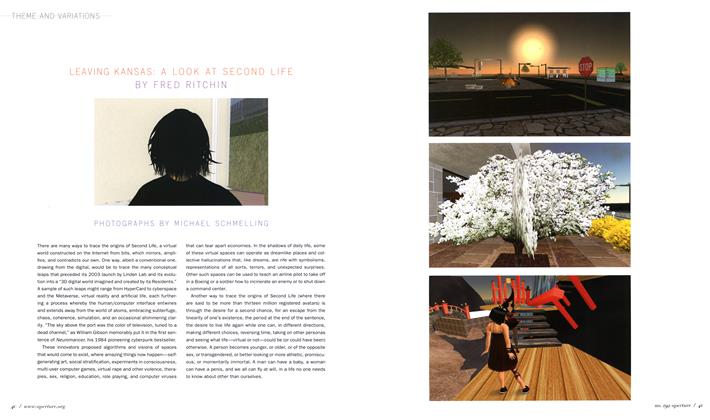 Theme And Variations
Leaving Kansas: A Look At Second Life
Fall 2008 -
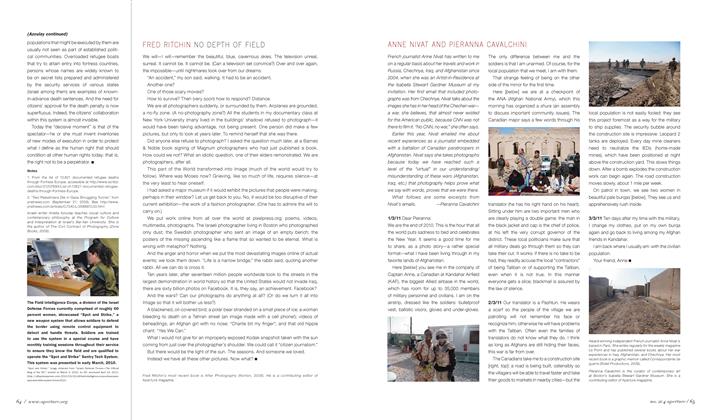 The Anxiety Of Images
Fred Ritchin No Depth Of Field
Fall 2011 -
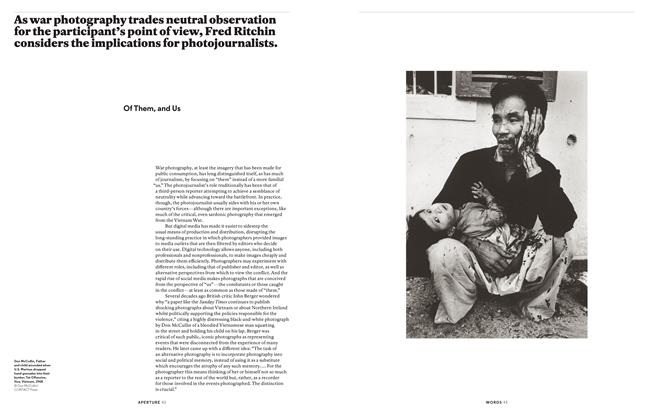 Words
WordsOf Them, And Us
Spring 2014 -
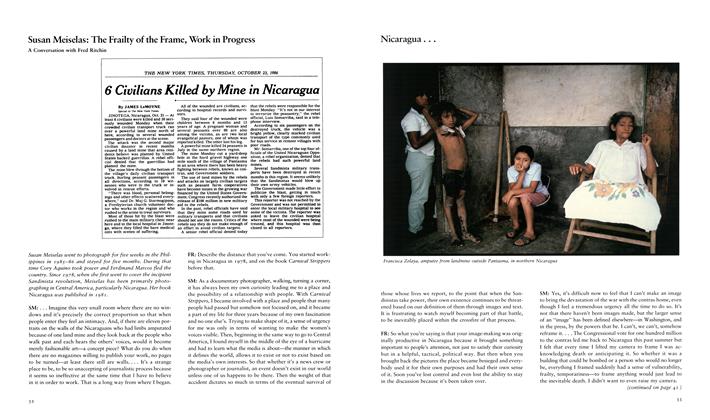
Susan Meiselas: The Frailty Of The Frame, Work In Progress
Fall 1987
People And Ideas
-
 People And Ideas
Looking At Lange
Spring 1978 -
 People And Ideas
Issyk-Kul: A Conversation With Gorbachev
Fall 1987 -
 People And Ideas
Polemical Pillow Talk Strange Bedfellows In Strawberry And Chocolate
Fall 1995 -
 People And Ideas
Stowaway Sublimity
Fall 1998 -
 People And Ideas
Soviet Filmmakers
Fall 1989 -
 People And Ideas
Influence And Inspiration: Francis Bacon, John Deakin, And Photography
Fall 1996


