People And Ideas
Pseudohistory/pseudophotography: A Review Of Walker Evans At Work And Bearing Witness
Pseudohistory/Pseudophotography: A Review of Walker Evans at Work and Bearing Witness
When the poet Walt Whitman died in Camden, New Jersey, there were many close to him who took an intense interest in everything about him, for among the faithful he was an overwhelming figure. An autopsy was ordered and Whitman's brain was removed to be examined and preserved. But a laboratory technician dropped the brain of America’s greatest poet on the floor. It broke into pieces and had to be discarded.
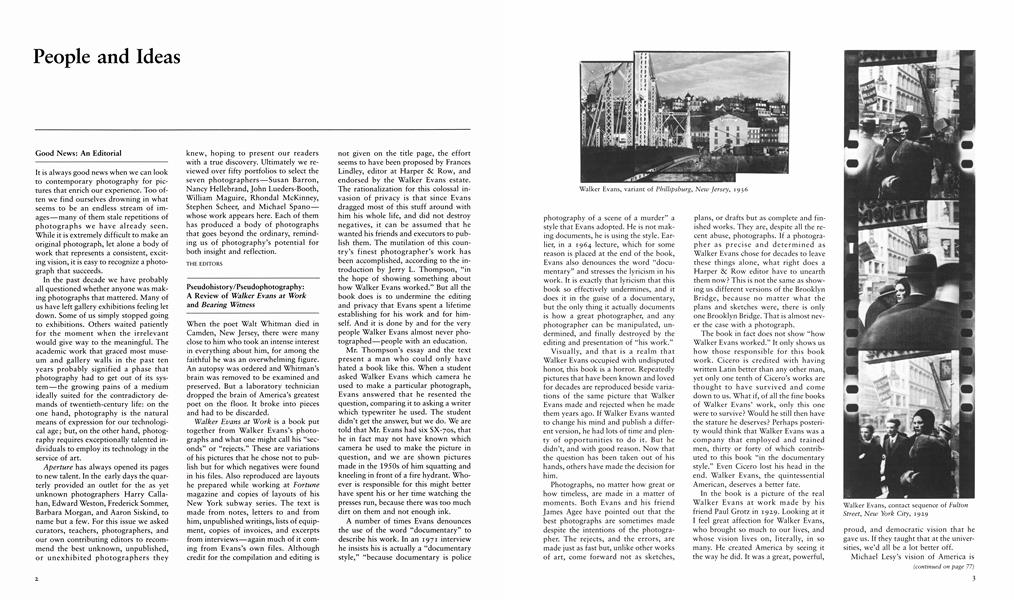
Walker Evans at Work is a book put together from Walker Evans’s photographs and what one might call his “seconds” or “rejects.” These are variations of his pictures that he chose not to publish but for which negatives were found in his files. Also reproduced are layouts he prepared while working at Fortune magazine and copies of layouts of his New York subway series. The text is made from notes, letters to and from him, unpublished writings, lists of equipment, copies of invoices, and excerpts from interviews—again much of it coming from Evans’s own files. Although credit for the compilation and editing is not given on the title page, the effort seems to have been proposed by Frances Lindley, editor at Harper & Row, and endorsed by the Walker Evans estate. The rationalization for this colossal invasion of privacy is that since Evans dragged most of this stuff around with him his whole life, and did not destroy negatives, it can be assumed that he wanted his friends and executors to publish them. The mutilation of this country’s finest photographer’s work has been accomplished, according to the introduction by Jerry L. Thompson, “in the hope of showing something about how Walker Evans worked.” But all the book does is to undermine the editing and privacy that Evans spent a lifetime establishing for his work and for himself. And it is done by and for the very people Walker Evans almost never photographed—people with an education.
Mr. Thompson’s essay and the text present a man who could only have hated a book like this. When a student asked Walker Evans which camera he used to make a particular photograph, Evans answered that he resented the question, comparing it to asking a writer which typewriter he used. The student didn’t get the answer, but we do. We are told that Mr. Evans had six SX-70S, that he in fact may not have known which camera he used to make the picture in question, and we are shown pictures made in the 1950s of him squatting and kneeling in front of a fire hydrant. Whoever is responsible for this might better have spent his or her time watching the presses run, because there was too much dirt on them and not enough ink.
A number of times Evans denounces the use of the word “documentary” to describe his work. In an 1971 interview he insists his is actually a “documentary style,” “because documentary is police photography of a scene of a murder” a style that Evans adopted. He is not making documents, he is using the style. Earlier, in a 1964 lecture, which for some reason is placed at the end of the book, Evans also denounces the word “documentary” and stresses the lyricism in his work. It is exactly that lyricism that this book so effectively undermines, and it does it in the guise of a documentary, but the only thing it actually documents is how a great photographer, and any photographer can be manipulated, undermined, and finally destroyed by the editing and presentation of “his work.”
Visually, and that is a realm that Walker Evans occupied with undisputed honor, this book is a horror. Repeatedly pictures that have been known and loved for decades are reproduced beside variations of the same picture that Walker Evans made and rejected when he made them years ago. If Walker Evans wanted to change his mind and publish a different version, he had lots of time and plenty of opportunities to do it. But he didn’t, and with good reason. Now that the question has been taken out of his hands, others have made the decision for him.
Photographs, no matter how great or how timeless, are made in a matter of moments. Both Evans and his friend James Agee have pointed out that the best photographs are sometimes made despite the intentions of the photographer. The rejects, and the errors, are made just as fast but, unlike other works of art, come forward not as sketches,
plans, or drafts but as complete and finished works. They are, despite all the recent abuse, photographs. If a photographer as precise and determined as Walker Evans chose for decades to leave these things alone, what right does a Harper &c Row editor have to unearth them now? This is not the same as showing us different versions of the Brooklyn Bridge, because no matter what the plans and sketches were, there is only one Brooklyn Bridge. That is almost never the case with a photograph.
The book in fact does not show “how Walker Evans worked.” It only shows us how those responsible for this book work. Cicero is credited with having written Latin better than any other man, yet only one tenth of Cicero’s works are thought to have survived and come down to us. What if, of all the fine books of Walker Evans’ work, only this one were to survive? Would he still then have the stature he deserves? Perhaps posterity would think that Walker Evans was a company that employed and trained men, thirty or forty of which contributed to this book “in the documentary style.” Even Cicero lost his head in the end. Walker Evans, the quintessential American, deserves a better fate.
In the book is a picture of the real Walker Evans at work made by his friend Paul Grotz in 1929. Looking at it I feel great affection for Walker Evans, who brought so much to our lives, and whose vision lives on, literally, in so many. He created America by seeing it the way he did. It was a great, powerful,
proud, and democratie vision that he gave us. If they taught that at the universities, we’d all be a lot better off.
Michael Lesy’s vision of America is neither great nor proud; it is best described as twisted, and he has imposed that vision with all his editorial might on his new book, Bearing Witness. This too is a book made by someone from someone else’s photographs, only in this case Lesy has made a profession of the process. Beginning with his Rutgers University thesis, published as Wisconsin Death Trip in 1973, he has produced four thematic books, using photographs to support the theme. Bearing Witness is Lesy’s selection of pictures from the immense photography collections of the Library of Congress, the National Archives, and the Pentagon.
(continued on page 77)
(continued from page 3)
Lesy has a fine eye for selecting photographs, and he can write well. He seems to look up to photographers, perhaps because he uses their pictures, and writes some romantic things about how the photographer works. But for all his admiration of them, he does not bother to place a credit line with their photographs. His most interesting writing is about the collections themselves, and in particular about the work of Paul Vanderbilt in creating them. But he has also written a lot of impenetrable junk laced with names like Jung, Goethe, and that of a medieval book maker he admires, although some of the books Lesy copies were printed much more recently.
By the second page of Lesy’s text I began to suspect he was nuts. By the third page Lesy writes that he did go a little nuts looking through all those photographs, and that might explain the rest of the book. Bearing Witness claims to be a photographic chronicle of American life from the years i860 to 1945. It is not. It is a tremendous manipulation of photographs, often great photographs, beautifully reproduced, to create a piece of photoliterature. It is Michael Lesy’s version of the American past, using photographs. But for me the work fails. I am offended by Lesy’s vision and his use of other people’s photographs to achieve it.
Lesy presents an America that gets grimmer and grimmer as the book progresses. It is mostly involved in wars. In fact about half his selections are about war, and it ends with pictures of European concentration camp survivors and Senator Barkley from Kentucky staring at a pile of corpses at Buchenwald. Since it is not mentioned in the text, I would like to point out that Americans did not build Buchenwald, we liberated it. The back of the book calls Mr. Lesy a “photographer/historian.” What makes a historian think that practically half the history of this country can be presented in a single volume containing a few hundred photographs?
I do not really object to Lesy’s trying to create a book of vision, manipulating photographs, or even using other people’s photographs. I object to his vision itself. It is much too private, and much too depressing to be presented as “a chronicle of American life.” I also happen to think it is inaccurate. Attacking the American past in 1982 is about as appropriate as kicking the dead bodies in the Buchenwald photograph. What is the point? A decade or two ago there was a purpose in bringing low the American image. Today, if there is any purpose, it is the opposite. It is a time to feel good about our lives, for that is all that we have.
There is another way to look at Mr. Lesy’s book. Skip the preface and the introduction by Lesy and look through the pictures as if they were a movie. Born from the Civil War, the work begins with a stunning landscape of soldiers and a grave at Antietam. The Indian camp at Deadwood and the Manhattan Bridge under construction are overwhelming pictures with which Lesy begins two of his chapters. We are, with photographs like these, racing through America, through incredible times, and growth and democratic glory. The tremendous variety and beauty of American landscapes and American people is before us. Much of that variety and beauty, of course, is now gone. Opening the section “Misfortunes” is another overpowering landscape of “the Johnstown flood,” similar to the picture of Antietam.
“Women after the War” opens with a group portrait of no less than a dozen young women who work as rivet passers, seated triumphantly before a navy ship. Taken twenty-four years later is another portrait of a young woman, this time “girl alone at the Sea Grill”—a woman waiting at a bar. Change and the speed of it has probably been the dominant fact of the century. Finally, America fights through World War II, and finds itself, through the figure of Senator Barkley, confronting the horror of the dead at Buchenwald. Not a very nice end to the story, but a kinder way to see Lesy’s work.
DANNY LYON
Walker Evans at Work. With an essay by Jerry L. Thompson. 239 pages, 745 photographs. New York: Harper & Row, 1982. $18.95.
Michael Lesy, Bearing Witness. 172 pages, 275 photographs. New York: Pantheon Books, 1982. Cloth, $27.50; paper, $15.00.
Danny Lyon
-
 People And Ideas
The Auschwitz Album
Winter 1982 -
Urban Combat
Fall 1984 -
 People And Ideas
Ain't Gonna Let Nobody Turn Me Round: Use And Misuse Of The Southern Civil Rights Movement
Summer 1989 -
 People And Ideas
Into The Abyss
Fall 1993 -
 Essay
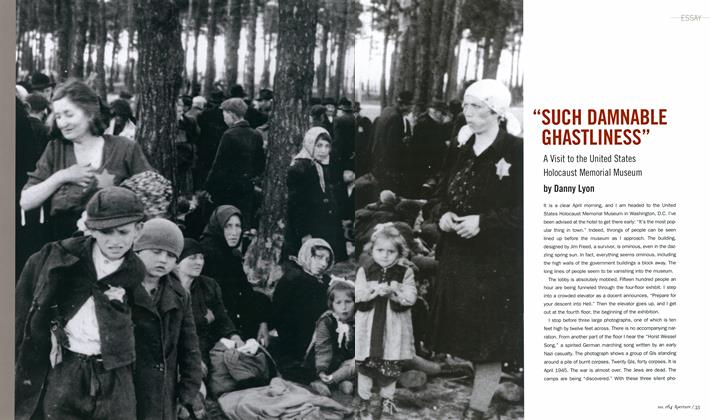
Essay"Such Damnable Ghastliness"
Summer 2001 -
 Reviews
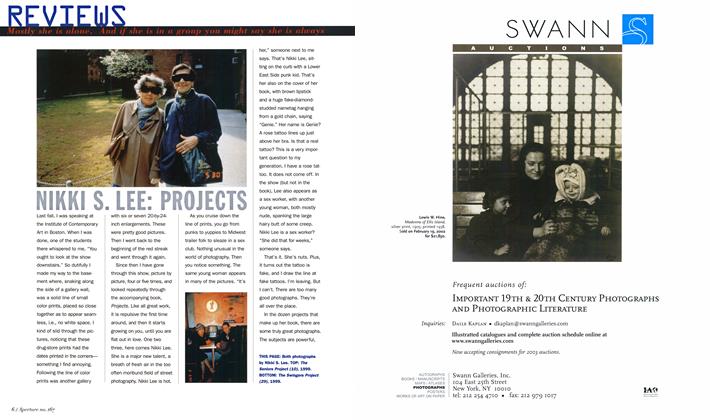
Nikki S. Lee: Projects
Summer 2002
People And Ideas
-
 People And Ideas
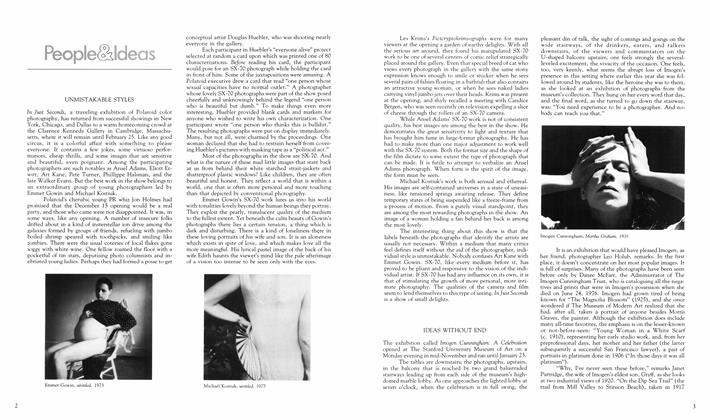
Unmistakable Styles
Winter 1977 -
 People And Ideas
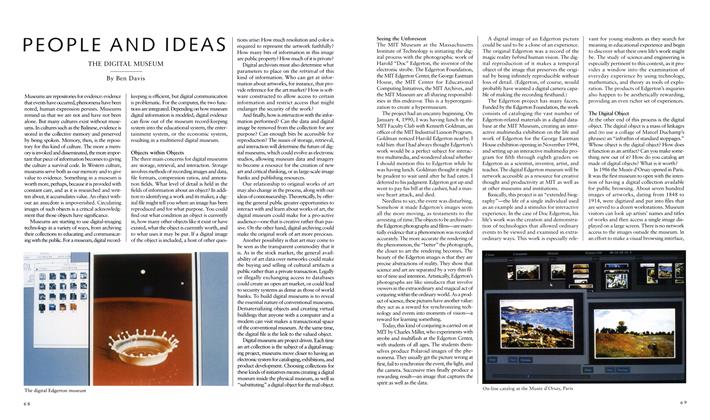
The Digital Museum
Summer 1994 -
 People And Ideas
On Our Own
Fall 1990 -
 People And Ideas
Camille Silvy: River Scene, France, Mark Haworth-Booth
Winter 1995 -
 People And Ideas
Men's Lives
Fall 1987 -
 People And Ideas
Politics And Photographs: Second Latin American Colloquium On Photography
Spring 1982


