1980s Edges of Illusion
At a time of burgeoning culture wars, artists confronted fundamentally political questions about identity.
1980s Edges of Illusion
At a time of burgeoning culture wars, artists confronted fundamentally political questions about identity.
Brian Wallis
“Photography was not a bastard left on the doorstep of art, but a legal child of the Western pictorial tradition,” insisted the Museum of Modern Art photography curator Peter Galassi in 1981, somewhat defensively. At the time, photography was still not widely accepted as a legitimate art form and was scarcely represented in the collections of major art museums. Art and photography existed in distinct and separate domains. Fine-art photography was pursued by the avid few and was always distinguished as being superior to commercial photography and photojournalism. Art photographers and curators generally seemed preoccupied with formalist issues of light and composition and with technical complications of equipment and analog printing—as opposed to, say, concerns of social or political import. The tiny world of art photography, with few galleries and little critical discourse, was largely dominated by two judgment seats: the photography department of the Museum of Modern Art (MoMA), then headed by the curator John Szarkowski, and the book and magazine publisher Aperture, guided by its executive director, Michael E. Hoffman. These two institutions functioned, often in tandem, as the principal advocates for the validity of photography as an artistic medium.
The issue for most viewers was not that photography was too modernist or too experimental but rather that it was either too ubiquitous or too esoteric to take seriously, an arcane subject best left to connoisseurs and elderly men with muttonchops. This last position was always symbolized for me by the black-and-white image on the cover of the Spring 1980 Aperture magazine: August Sander’s 1931 portrait Pharmacist, Linz, a full-length standing view of a stout and rather severe German man with white hair and beard, dressed in a conservative three-piece suit, feet planted firmly apart, one hand thrust into his pocket. This was old-school photography. The monographic text by the historian Beaumont Newhall, who had founded the MoMA photography department in 1940, emphasized the traditional, documentary quiddity of Sander’s straight photography. Newhall approvingly quoted Sander’s 1931 radio lecture in which he stated: “The essence of all photography is of a documentary nature, but it can be uprooted by manual treatment.... If we compare, we will ascertain that a photograph produced with the aid of chemicals is far more aesthetic than one muddled by artificial manipulation.”
For me, Sander’s self-satisfied pharmacist symbolized the perceived authority of the largely male-dominated photography community of the time. His assertiveness was an allegory for rock-solid confidence in a knowable version of reality as depicted by photography, and commonly accepted as realist evidence, or “the truth.” But at that very moment in the early 1980s, photographic truth and the traditional modernist notions of authenticity and objectivity were being roundly challenged by an upstart band of contemporary artists and postmodernist critics. Influenced by French theoretical models, writers on photography, such as Rosalind Krauss, Craig Owens, Abigail Solomon-Godeau, Douglas Crimp, Martha Rosier, and Allan Sekula, argued that photographic representations were not neutral evidence but adhered to historically specific and ideologically freighted concepts meant to serve regulatory social and political goals.
Their provocative arguments were articulated in publications on art, photography, and critical theory ranging from the recondite October, to the glitzy Artforum, to a proliferation of smaller journals such as Screen, Afterimage, BOMB, Block, Wedge, Semiotext(e), and REALLIFE Magazine. This discursive framework encouraged surprisingly innovative artistic practices among a small cadre of New York artists. Refusing to be labeled photographers, these “artists using photography,” as they called themselves, active in the late 1970s and early 1980s, included Richard Prince, Sherrie Levine, Sarah Charlesworth, James Welling, Barbara Kruger, and Cindy Sherman, among others. Having been raised on a fulsome diet of television, film, advertising, and broadcast news, these artists adopted such media-savvy tactics as appropriation, rephotography, montage, staged images, bold typography and graphics, parody, and humor to skewer photographic pretensions.
Halfway through the decade, Aperture—now just one among a growing number of publications of cultural criticism— finally addressed this alarming rupture in the otherwise selfconfident practices of straight photography. For the Fall 1985 issue, the magazine’s one hundredth, pointedly titled “The Edge of Illusion,” the seemingly bewildered editors reported that “the representational, descriptive intentions of so much 19th-century photography, and the modernism and symbolism of Stieglitz’s equivalence, remain permanent qualities of the photographic tradition. In 1985, that tradition is challenged not only by photographers but by those artists whose work is derived from photographic practice. They provide profound comment on the nature of photographic evidence.... The sanctity of the photographic print is overturned, exposing a tradition from which so much of this work appears divorced.” As if to prove this point, the issue included a rather jarring interview with the artist Richard Prince, then known primarily for rephotographing magazine advertisements. Though glib about his uses of photography,
Prince was remarkably clear about his mission: “I’m not just making another fiction. That wouldn’t interest me at all. I’m interested in the fiction becoming true.... The fact that my pictures already exist in public helps to establish their reality. I obviously don’t make the images up. My style is hopefully a convincing style. Rephotography is photographing what’s already been determined, so obviously rephotography is about overdetermination. Basically, I’m not interested in impressions, and I like to think I’m in the habit of telling the truth.”
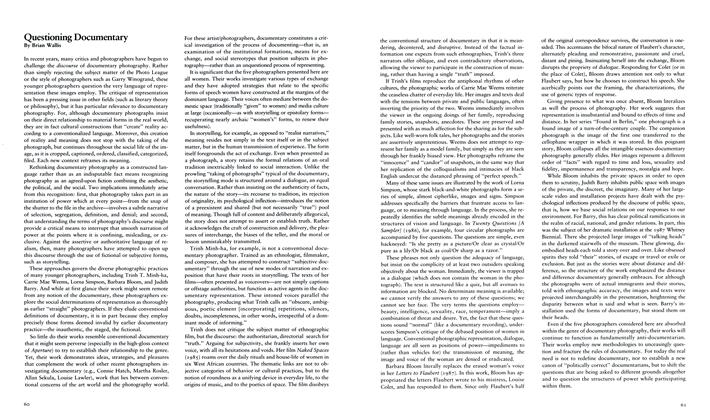
Three years later, as a young writer, I published my own critical take on photographic fictions inAperture’s Fall 1988 issue, with an essay titled “Questioning Documentary.” Advocating for lesser-known nonwhite and nonmale photographers—or, at least, artists using photography—I cited the works of Judith Barry, Barbara Bloom, Lorna Simpson, Trinh T. Minh Ha, and Carrie Mae Weems as revealing an original direction for the medium.
These artists saw photography not as fixed imagery but rather as a constructed language with fluid meanings that changed with each new context and subjective reading. Using found photographs and texts, their works claimed an active role for the viewer and sought to intervene in the implacable truth of photography through the skillful adaptation of fictional narratives or other forms of storytelling—the inauthentic, the staged, the imaginary.
These deliberate recastings of modes of address and this wholesale refashioning of phallocentric photographic representation were often presented by postmodernist artists with deft irony and humor; one prominent 1983 exhibition was titled The Revolutionary Power of Women’s Laughter. Fiercely feminist artists sought to turn the patriarchal photographic gaze on itself: Sherrie Levine repositioned prominent photographic icons by male photographers as if seen through her own authorship; Cindy Sherman in her Untitled Film Stills (1977-80) placed women in vulnerable positions before an implicitly predatory male viewer; and Barbara Kruger used pungent pronouns typographically overlaid on found photographs to reveal abusive masculine privilege (“Your gaze hits the side of my face”). Often these works had a public manifestation. For a major pro-choice march in Washington, D.C., in April 1989, Kruger designed a flyer that featured text over the black-and-white photograph of a woman’s face divided into negative and positive halves. The words announced, “Your body is a battleground.” Between 1987 and 1990, many collectives devoted to AIDS activism, such as ACT UP and Gran Fury, also adopted such declamatory uses of text and photographic images on public art, videos, and posters to challenge the U.S. government’s willful inaction and public silence in response to the AIDS crisis.
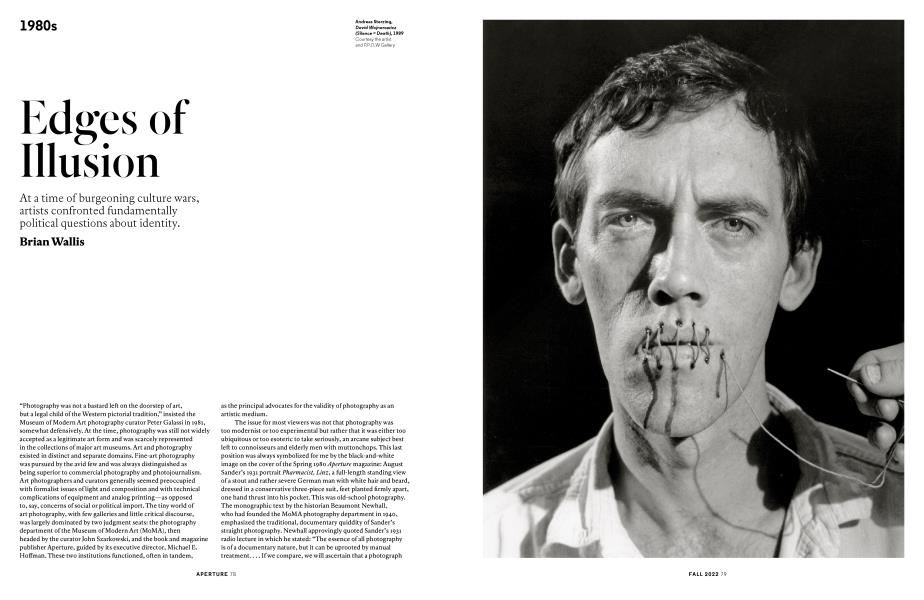
The increasing visibility of feminist, queer, and nonwhite artists with urgent and subversive political messages ultimately drew the attention and ire of conservative American politicians. Virulent public opposition to individual works or series by the photographers Robert Mapplethorpe, Andres Serrano, and David Wojnarowicz, in particular, challenged the legality and public display of certain controversial depictions of sexuality, religion, and patriotism. Their uses of photography to engage fundamentally political questions elicited a firestorm of national controversy around art, known as the “culture wars.” In 1989, congressional authorities sought to curtail grants to a regional art space for showing the work of Serrano; later the same year, the National Endowment for the Arts withdrew funding for an Artists Space exhibition on AIDS for publishing an essay by Wojnarowicz; and in 1990, the director of the Contemporary Arts Center in Cincinnati was brought to court and charged with obscenity for showing photographs by Mapplethorpe. Rather than a critical judgment on the work itself, the operative political issue became the rights of these artists to speak out, to show certain photographs, and to make unabridged comments in public spaces.
The increasing visibility of feminist, queer, and nonwhite artists with subversive political messages ultimately drew the ire of conservative American politicians.
These national debates were forthrightly addressed in what might be considered the last Aperture magazine of the 1980s, the remarkable Fall 1990 number titled “The Body in Question.” Tackling questions of sexual representation and censorship head-on, this issue marked a conspicuous departure from Aperture’s past valorization of apolitical versions of photography. It featured essays by the noted writers Carole S. Vance, Edward de Grazia,
Tom Kalin, Katherine Dieckmann, and Allen Ginsberg, and bravely published Wojnarowicz’s contentious Sex Series (1989). Even more conspicuous and controversial was the publication on its cover of Sally Mann’s daring image of her four-year-old daughter Virginia, standing stark naked, arms akimbo. With her defiant frontal stance, Virginia Mann provides a striking visual contrast to Sander’s conservative German pharmacist published ten years earlier. Between these two Aperture covers lay a decade in which the social purpose and meaning of photography and visual culture was repeatedly raised and questioned. What appeared at the time to be a political flashpoint or an epistemological debate might, in retrospect, be seen as a revolution in thinking about photography.
Brian Wallis is a regular contributor to Aperture.