Witness
Eyes On A Fast World The World Press Photo Contest 2004
EYES ON A FAST WORLD The World Press Photo Contest 2004
WITNESS
ELISABETH BIONDI
Early this year, I traveled to Amsterdam and, along with other members of an international jury, looked at the 63,093 images that were entered in the World Press Photo Contest. Over a two-week period of concentrated sessions, we awarded prizes for most outstanding stories and individual pictures in ten categories, from Spot News to Daily Life to Nature. Last came the selection of the World Press Picture of the Year for 2003. Making this final choice was, of course, a difficult job—and yet there was something almost self-evident about it as well.
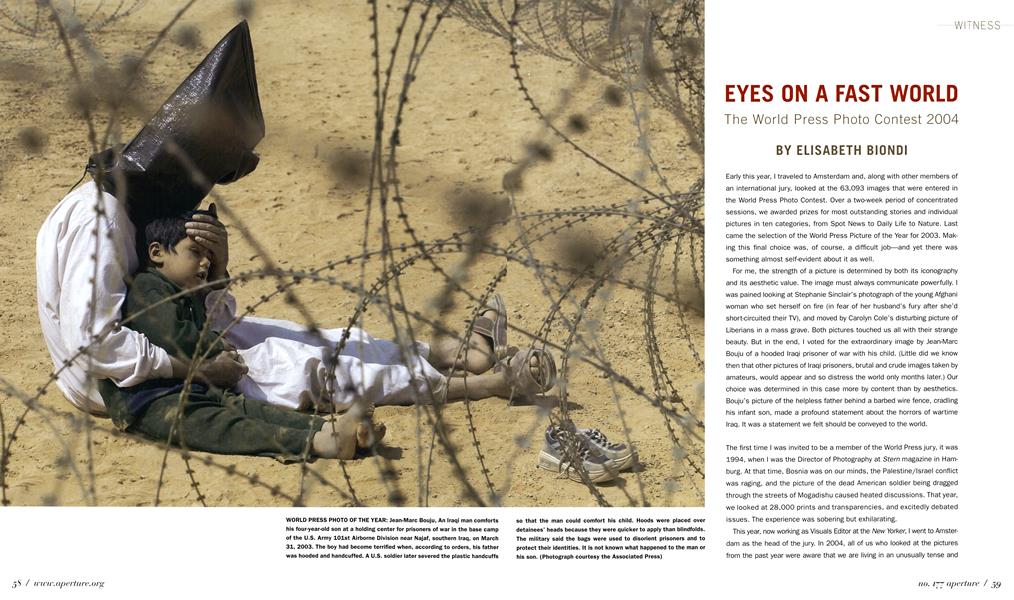
For me, the strength of a picture is determined by both its iconography and its aesthetic value. The image must always communicate powerfully. I was pained looking at Stephanie Sinclair’s photograph of the young Afghani woman who set herself on fire (in fear of her husband’s fury after she’d short-circuited their TV), and moved by Carolyn Cole’s disturbing picture of Liberians in a mass grave. Both pictures touched us all with their strange beauty. But in the end, I voted for the extraordinary image by Jean-Marc Bouju of a hooded Iraqi prisoner of war with his child. (Little did we know then that other pictures of Iraqi prisoners, brutal and crude images taken by amateurs, would appear and so distress the world only months later.) Our choice was determined in this case more by content than by aesthetics. Bouju’s picture of the helpless father behind a barbed wire fence, cradling his infant son, made a profound statement about the horrors of wartime Iraq. It was a statement we felt should be conveyed to the world.
The first time I was invited to be a member of the World Press jury, it was 1994, when I was the Director of Photography at Stem magazine in Hamburg. At that time, Bosnia was on our minds, the Palestine/lsrael conflict was raging, and the picture of the dead American soldier being dragged through the streets of Mogadishu caused heated discussions. That year, we looked at 28,000 prints and transparencies, and excitedly debated issues. The experience was sobering but exhilarating.
This year, now working as Visuals Editor at the New Yorker, I went to Amsterdam as the head of the jury. In 2004, all of us who looked at the pictures from the past year were aware that we are living in an unusually tense and complicated time. September 11, 2001 had changed everyone’s lives. This year, Iraq was at the center of our discussions.
Hundreds of photographers were in Iraq at the beginning of the war, and thousands of their images were submitted to World Press Photo. The good news was that, compared with ten years ago, the general level of photography had dramatically improved. Yet the number of truly memorable stories and images seemed not to have grown at the same rate. What had changed over the course of a decade?
The most obvious and dramatic development, of course, is the widespread use of digital photography. This year (with some notable exceptions, such as Luc Delahaye, Alexandra Boulât, and Stanley Greene), photojournalists transmitted their images directly from Iraq, making this the first “digital war.” The increased speed makes for a fundamental change in the way photojournalists work—for better, and sometimes for worse.
One advantage of digital technology is obvious: images can be seen, edited, and printed almost instantaneously. News media and audiences now receive instant photojournalism. Also, digital cameras make the technical process easier and can produce technically more “perfect” images, as well as offering great latitude in low-light situations. And the photographer has the freedom to see, store, and dispose of images immediately.
The drawbacks are less obvious. The digital process places new demands on photographers, especially in conflict situations. At the end of each day of shooting, often in life-threatening conditions, the photojournalist must transmit pictures—with captions—back to the publication or the agency that awaits them. This is a time-consuming and often frustrating task that can add up to six hours to the photographer’s workday. There is little time for careful editing, and perhaps no time at all for oldfashioned story weaving. The photographer is deprived of the valuable process of reflection. Every night, instead of thinking ahead and planning the next move, the exhausted photojournalist must begin the tedious job of archiving the day’s images. James Nachtwey puts it bluntly: “The digital cleanup interferes with the journalistic process.” Additionally, there is a curious backward-looking mechanism to digital picture-taking. Instead of focusing on the next image, photographers may be tempted to glance down at the image just taken—and thus may easily miss the ensuing “moment.” Photojournalists have words for this: a “chipmunk" photographer instantly edits while shooting—a process called “chimping”—allowing little room for composition or thought. How conducive is this to producing lasting images?
Finnish photojournalist llkka Uimonen, who received a prize in the Spot News category, is one of the few who successfully straddles digital and nondigital media. He was on assignment in Iraq for eight weeks and, like everyone who worked for newsmagazines, transmitted his digital images home nightly. But he also carried a rangefinder camera and shot black-andwhite film, “on the periphery,” as he says. His are not the only memorable pictures from Iraq, but they are particularly powerful. By allowing himself the freedom to work at his own pace, Uimonen made photographs that are introspective, lyrical, and elusively seductive.
It became evident in Amsterdam that certain events were covered by a great number of photographers; consider the thousands of images of the fall of Saddam’s statue. The process of “embedding” journalists was intended to control (at least to a certain extent) images sent back to the media; and indeed, in the first weeks of the war it did considerably limit photographers’ access. Perhaps, too, the shortage of time to develop and plot out a story contributed to the numbers of photojournalists all covering the same situations.
The new speed and technology, and strictly delimited photographiable terrain, have made it particularly difficult during this conflict for a photographer to preserve an independent personal vision. A few have managed to maintain a strong visual “handwriting” in both digital and nondigital images. Some, such as Simon Norfolk, have purposefully chosen the slower, nondigital process of large-format cameras; others use black-and-white film, casting a “slow eye” on a fast-paced world.
As the use of digital photography expands, and as a new generation of photographers falls in love with the ease of this new technology, we can expect yet greater floods of images. No doubt the submissions for World Press Photo 2005 will be even more copious than they were this year. Photography is constantly evolving, and with improving technology, photographers will surely test new creative limits. At the same time, there are and always will be others who choose to let their images stand out from the digital masses by allowing time to work slowly for them. We saw some exceptional photographs by these new “mavericks” at World Press 2004. They will surely be there next year as well, and I hope the one after, and the one after that. ©
More From This Issue
-
 Work And Process
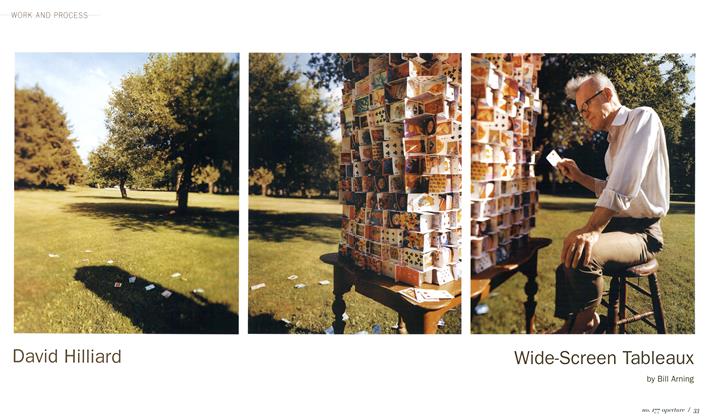
David Hilliard Wide-Screen Tableaux
Winter 2004 -
 Archive
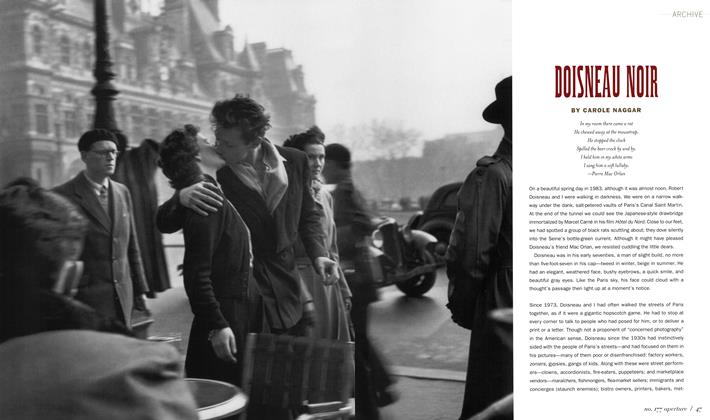
Doisneau Noir
Winter 2004 -
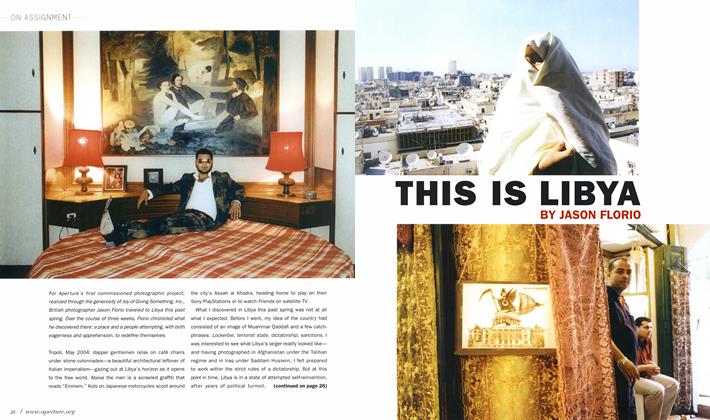 On Assignment
This Is Libya
Winter 2004 -
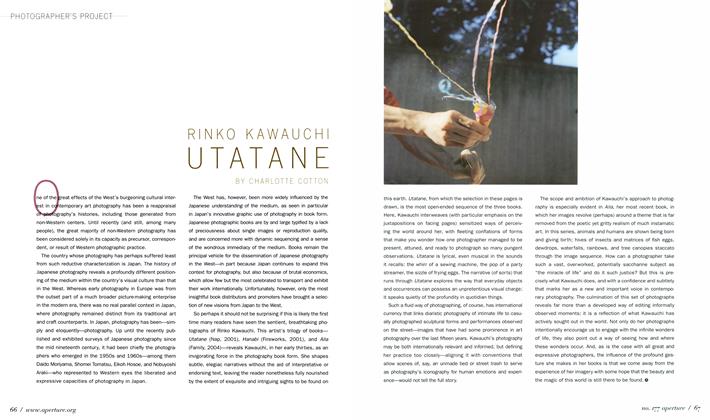 Photographer's Project
Rinko Kawauchi Utatane
Winter 2004 -
 Book Excerpts
Geoffrey Batchen: Forget Me Not: Photography & Remembrance
Winter 2004 -
Book Excerpts
Bruno Stevens: Baghdad: Truth Lies Within
Winter 2004
Witness
-
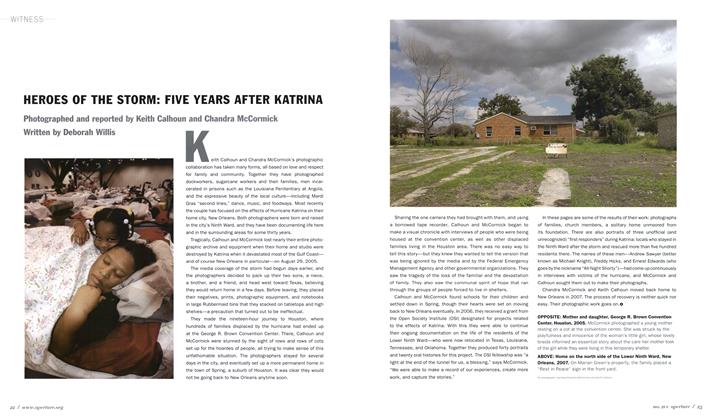 Witness
Heroes Of The Storm: Five Years After Katrina
Fall 2010 -
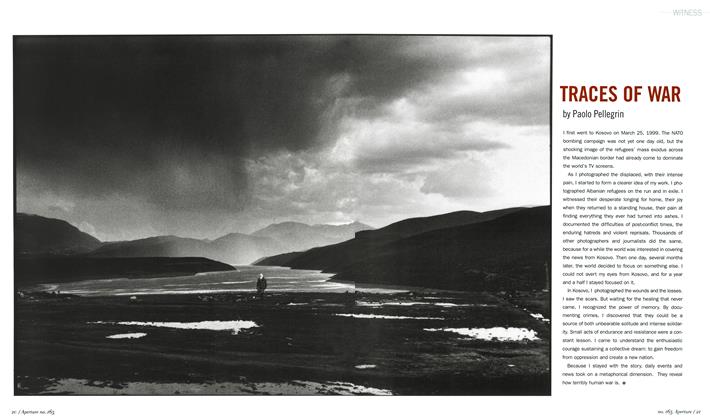 Witness
Traces Of War
Winter 2001 -
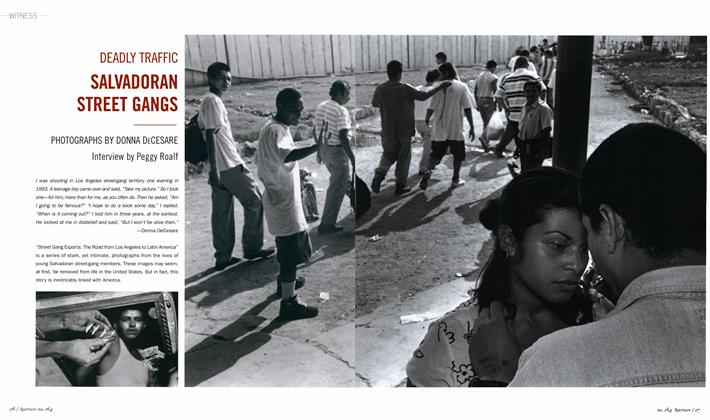 Witness
Deadly Traffic Salvadoran Street Gangs
Summer 2001 -
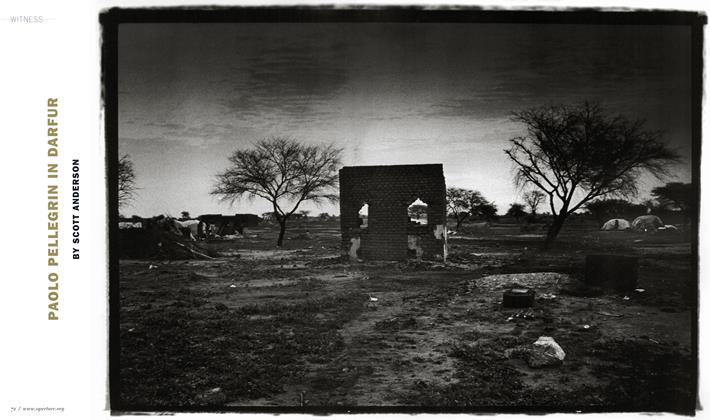 Witness
Paolo Pellegrin In Darfur
Spring 2006 -
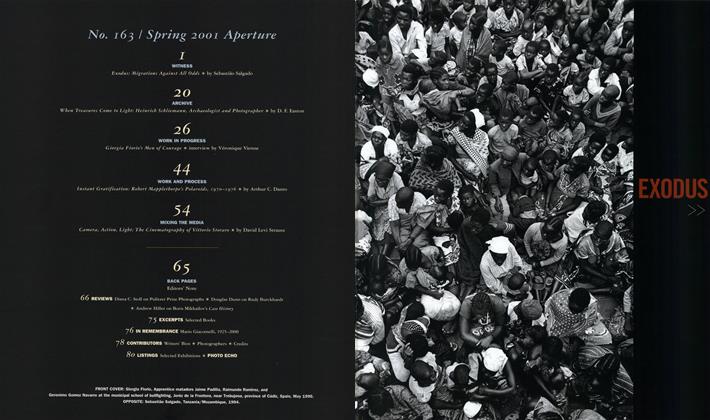 Witness
Exodus Migrations Against All Odds
Spring 2001 -
 Witness
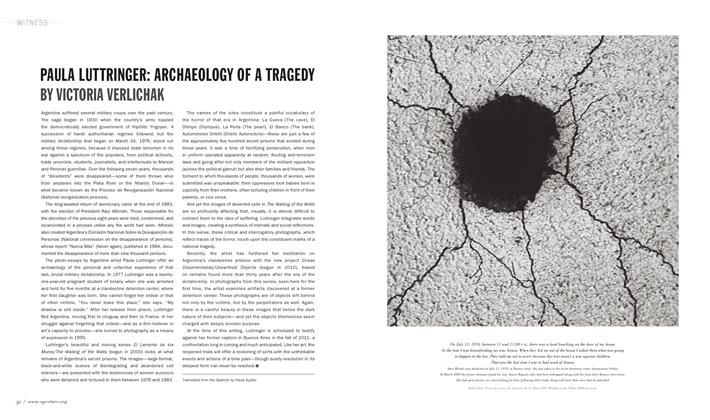
Paula Luttringer: Archaeology Of A Tragedy
Spring 2012


