Reviews
Andreas Gursky
ANDREAS GURSKY
REVIEWS
Ihe camera's enormous distance from these figures means that they becoi~e de-individualized. So I am never interested in the individual9 but in the human species c md its environment. . . . —Andreas Gursky
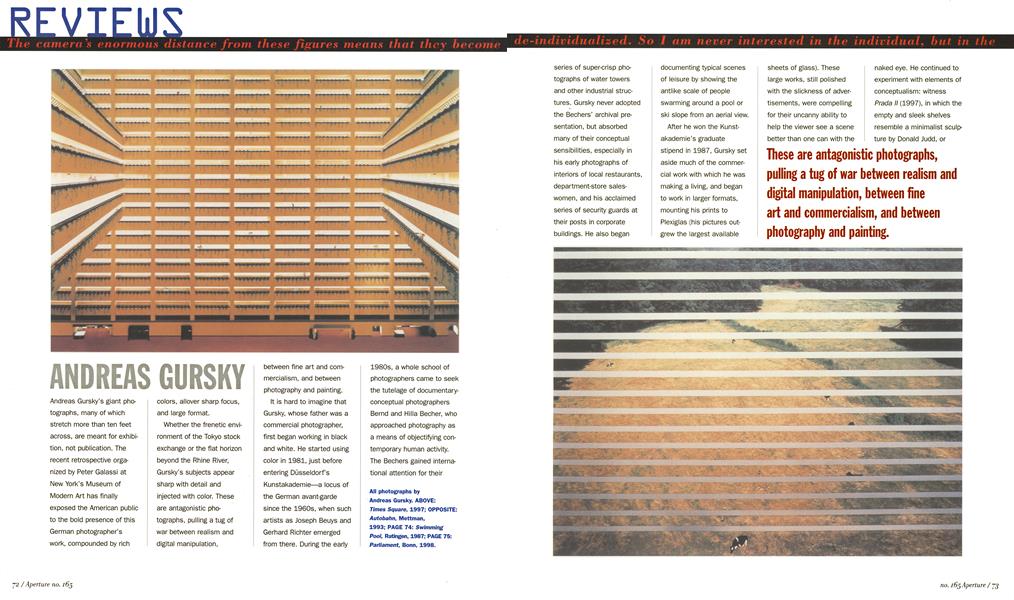
Andreas Gursky's giant photographs, many of which stretch more than ten feet across, are meant for exhibition, not publication. The recent retrospective organized by Peter Galassi at New York's Museum of Modem Art has finally exposed the American public to the bold presence of this German photographer's work, compounded by rich colors, allover sharp focus, and large format.
Whether the frenetic environment of the Tokyo stock exchange or the flat horizon beyond the Rhine River, Gursky’s subjects appear sharp with detail and injected with color. These are antagonistic photographs, pulling a tug of war between realism and digital manipulation,
between fine art and commercialism, and between photography and painting.
It is hard to imagine that Gursky, whose father was a commercial photographer, first began working in black and white. He started using color in 1981, just before entering Düsseldorfs Kunstakademie—a locus of the German avant-garde since the 1960s, when such artists as Joseph Beuys and Gerhard Richter emerged from there. During the early
1980s, a whole school of photographers came to seek the tutelage of documentaryconceptual photographers Bernd and Hilla Becher, who approached photography as a means of objectifying contemporary human activity. The Bechers gained international attention for their series of super-crisp photographs of water towers and other industrial structures. Gursky never adopted the Bechers’ archival presentation, but absorbed many of their conceptual sensibilities, especially in his early photographs of interiors of local restaurants, department-store saleswomen, and his acclaimed series of security guards at their posts in corporate buildings. He also began documenting typical scenes of leisure by showing the antlike scale of people swarming around a pool or ski slope from an aerial view. After he won the Kunstakademien graduate stipend in 1987, Gursky set aside much of the commercial work with which he was making a living, and began to work in larger formats, mounting his prints to Plexiglas (his pictures outgrew the largest available sheets of glass). These large works, still polished with the slickness of advertisements, were compelling for their uncanny ability to help the viewer see a scene better than one can with the naked eye. He continued to experiment with elements of conceptualism: witness Prada II (1997), in which the empty and sleek shelves resemble a minimalist sculpture by Donald Judd, or Paris, Montparnasse (1993), which depicts an apartment building of International Style architecture much like a color-grid painting by Richter. The processed aesthetic and billboard bravado of his photographs prompts a question: what makes Gursky’s work resonate any more than the pervasive imagery of advertising and media? Gursky distills his images of crowds, architecture, and nature by emphasizing the key components of each composition, namely by using digital manipulation to doctor his images. With the help of a digital tweak here and there, Gursky aestheticizes even a ninety-nine-cent discount store or the dreary Autobahn cutting through a stretch of fading grass. He seduces the viewer with the most stimulating patterns of shape and color, and with all the control of a painter. ©
These are antagonistic photographs, pulling a tug of war between realism and digital manipulation, between fine art and commercialism, and between photography and painting.
These large works, still polished with the slickness of advertisements, [are] compelling in their uncanny ability to help the viewer see a scene better than one can with the naked eye.
Lynda Hammes
“Andreas Gursky" appeared in 2001 at the Museum of Modern Art,
New York City and at the Reina Sofia, Madrid; it will be presented at the Centre Georges Pompidou, Paris, March 13-May 8, 2002, and at the Chicago Museum of Contemporary Art, June 15-September 22, 2002.
Reviews
-
 Reviews
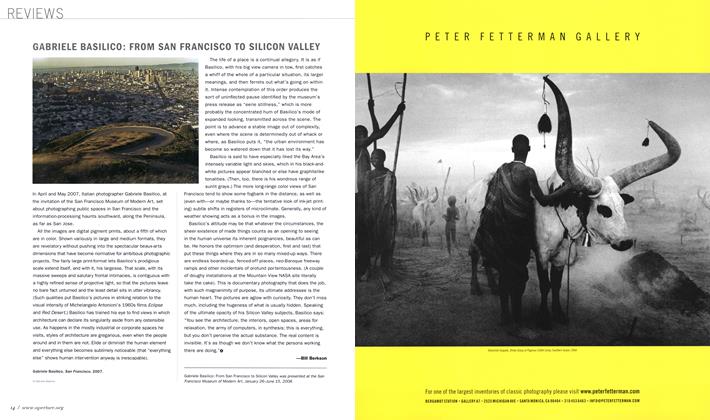
Gabriele Basilico: From San Francisco To Silicon Valley
Fall 2008 -
 Reviews
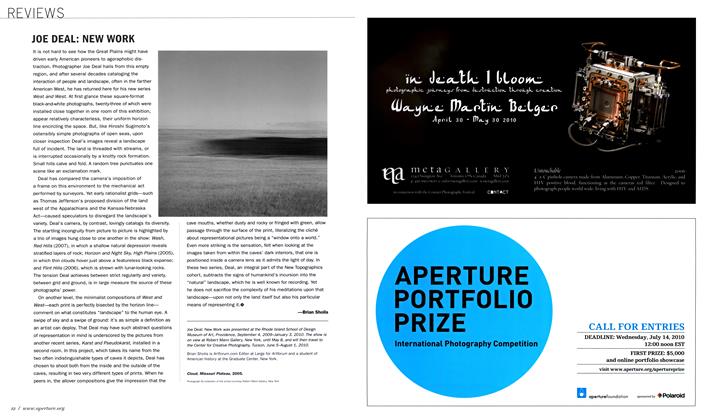
Joe Deal: New Work
Summer 2010 -
 Reviews
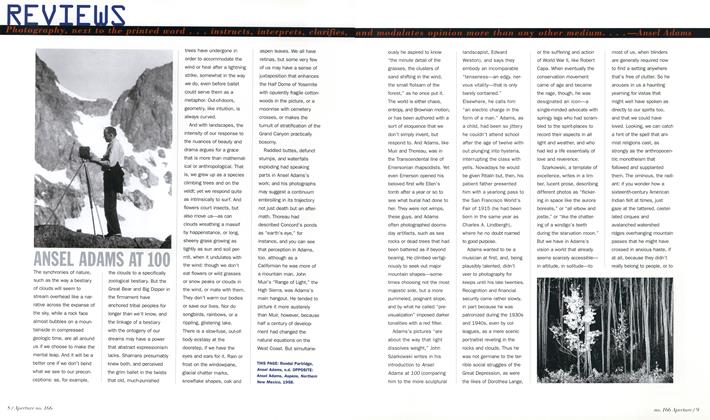
Ansel Adams At 100
Spring 2002 -
 Reviews
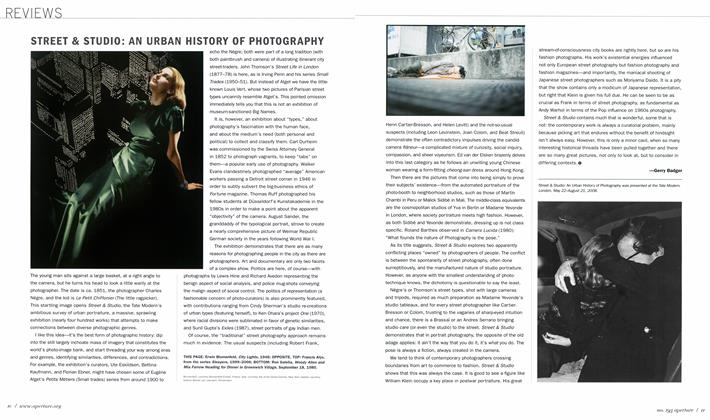
Street & Studio: An Urban History Of Photography
Winter 2008 -
 Reviews
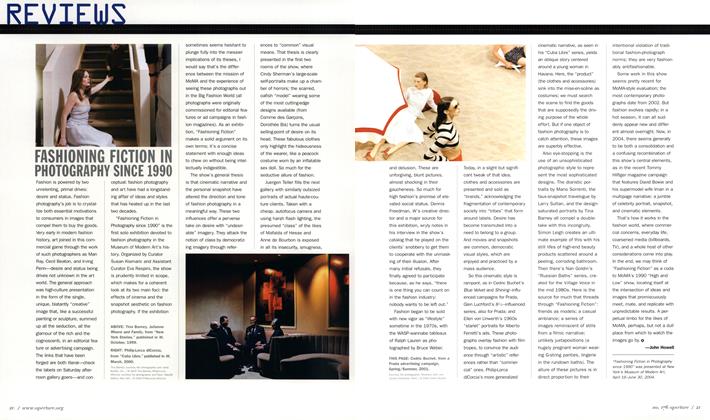
Fashioning Fiction In Photography Since 1990
Fall 2004 -
 Reviews
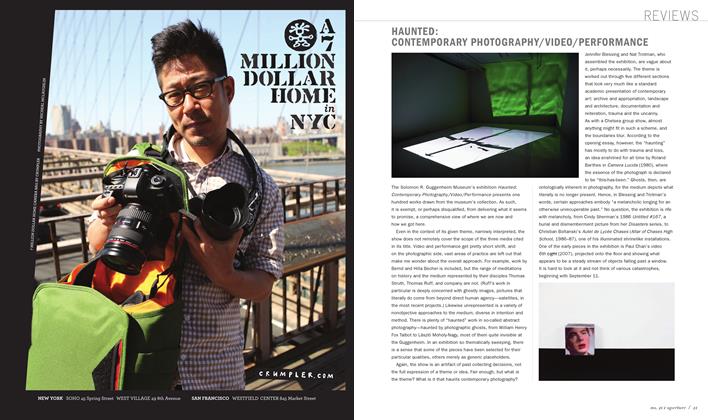
Haunted: Contemporary Photography/video/performance
Winter 2010


