The Books Of Carlos Castaneda
POSTSCRIPT
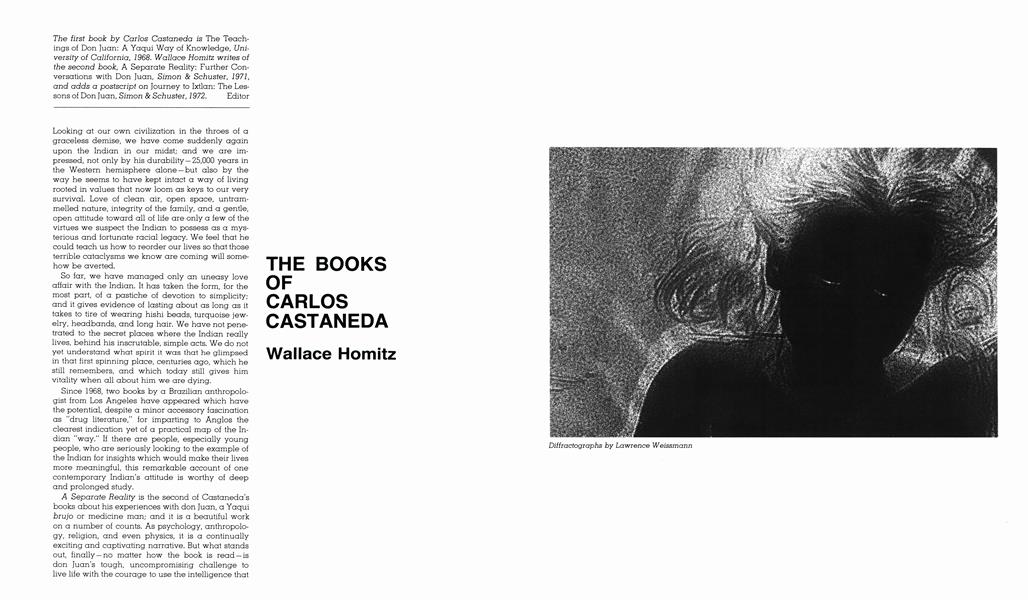
THE BOOKS OF CARLOS CASTANEDA
Wallace Homitz
The first hook by Carlos Castaneda is The Teachings of Don Juan: A Yaqui Way of Knowledge, University of California, 1968. Wallace Homitz writes of the second book, A Separate Reality: Further Conversations with Don Juan, Simon & Schuster, 1971, and adds a postscript on Journey to Ixtlan: The Lessons of Don Juan, Simon & Schuster, 1972. Editor
Looking at our own civilization in the throes of a graceless demise, we have come suddenly again upon the Indian in our midst; and we are impressed, not only by his durability—25,000 years in the Western hemisphere alone —but also by the way he seems to have kept intact a way of living rooted in values that now loom as keys to our very survival. Love of clean air, open space, untrammelled nature, integrity of the family, and a gentle, open attitude toward all of life are only a few of the virtues we suspect the Indian to possess as a mysterious and fortunate racial legacy. We feel that he could teach us how to reorder our lives so that those terrible cataclysms we know are coming will somehow be averted.
So far, we have managed only an uneasy love affair with the Indian. It has taken the form, for the most part, of a pastiche of devotion to simplicity; and it gives evidence of lasting about as long as it takes to tire of wearing hishi beads, turquoise jewelry, headbands, and long hair. We have not penetrated to the secret places where the Indian really lives, behind his inscrutable, simple acts. We do not yet understand what spirit it was that he glimpsed in that first spinning place, centuries ago, which he still remembers, and which today still gives him vitality when all about him we are dying.
Since 1968, two books by a Brazilian anthropologist from Los Angeles have appeared which have the potential, despite a minor accessory fascination as "drug literature," for imparting to Anglos the clearest indication yet of a practical map of the Indian "way." If there are people, especially young people, who are seriously looking to the example of the Indian for insights which would make their lives more meaningful, this remarkable account of one contemporary Indian's attitude is worthy of deep and prolonged study.
A Separate Reality is the second of Castaneda's books about his experiences with don Juan, a Yaqui brujo or medicine man; and it is a beautiful work on a number of counts. As psychology, anthropology, religion, and even physics, it is a continually exciting and captivating narrative. But what stands out, finally —no matter how the book is read —is don Juan's tough, uncompromising challenge to live life with the courage to use the intelligence that our daily experience is constantly giving us. To apply precision to our lives, to perform every act as if it were in itself the source of a share of Nature's infinite creative freedom, is to open the door to another reality.
That this reality to some represents magic, that it appears as a play of extra-sensory perceptions, or that it sometimes reveals itself after an alteration of body chemistry by drugs, is interesting, but not significant as an organic part of don Juan's teachings. He pointedly discredits the use of drugs except in the hands of brujos, and belittles as well extraordinary powers, except as aids to, or concomitants of, greater knowledge. The heart of this book is about "seeing" the truth and the way to live life so that one may reach the point where one "sees."
How, then, are we to live?
It would be useless to try to impose a structure, or system of principles and methods, on don Juan's thought. (Castaneda tried that at the end of his first book and failed.) But there are several major ideas which recur in the conversations and which radiate blueprints for living every situation, from the most inconsequential to the most heroic.
One of these ideas is there is another, "separate" reality operating within the world ordinarily described by our senses. It is a world where ordinary conceptions of time, possibilities, and relationships are utterly different from the world we usually see. We are not in touch with this reality because our "lot as human beings" is "total slumber." It is out of this slumber that we must "be shaken." If this is reminiscent of Plato's Allegory of the Cave, the Christian exhortation to awake, or even Shakespeare ("Sleep ... is the chief nourishment of life's feast"), it only serves to confirm the deeply human and universal dimensions of don Juan's thought.
To be shaken out of slumber is not a matter of luck or natural happenstance. It is accomplished only by "hard work" to overcome the fear which keeps us from waking up. But even before one can begin work, one must "want to become acquainted" with the waking state; and it must be experienced "many times before one can say one knows" the difference between it and sleep.
Once one has been roused from slumber often enough, one sees quite clearly that no single act is more important than any other act. This is another of the major ideas which don Juan presents. There is a danger of interpreting this realization as an indication that nothing matters, when in fact it is quite the other way around. Since no one act has intrinsically more value than any other, all acts are of equal importance; and the responsibility in action becomes even greater.
A man must therefore be watchful, lest he succumb to despair or indifference, or to being a clown, or to playing any of the games which come from the realization that the things men do are inherently useless. "We must first know that our acts are useless, yet we must proceed as if we didn't know it," don Juan says. This idea he calls "controlled folly," and it is perhaps the goal towards which all the other ideas lead. A man:
. . . knows that his life will he over altogether too soon; he knows that he, as well as everybody else, is not going anywhere; he knows, because he sees, that nothing is more important than anything else . . . a man of knowledge endeavors, sweats and puffs, and if one looks at him, he is just like any ordinary man except that the folly of his life is under control. Nothing being more important than anything else, a man of knowledge chooses any act and acts it out as if it mattered to him.
What don Juan is saying is that one may be a pacifist or a terrorist, a militant or a policeman, but the things one does will never be the measure of whether one is really alive or not. Only if all of our actions are performed with "all we have," with "unbending intention," deliberately, will we certify our existence, or open the door to reality. Life must become a constant sacrifice at the altar of gesture. Every act bears the possibility of tranforming the energy it takes to perform it into an energy that places us, in the very act, at the crack between the "two worlds."
Many of us have reached that idea intellectually; yet, our lives are no more precise, no less confusing than before. What is the difference? What would need to happen so that even if nothing changed outwardly, our relationship to life would be changed, and we would know it?
What that difference may be is indicated by don Genaro, another brujo, who stands "on his head without the aid of his arms or legs, and his legs crossed as if he were sitting." It is a beautifully ridiculous gesture designed to satirize Castaneda's perpetual note-taking while trying to conduct a conversation. In other words, Carlos is chained to his reason, his thought; his rear-end is where his head should be.
That Castaneda recognizes this enslavement as the crucial impediment in his search for reality is confirmed in a powerful scene which concludes the book. Don Juan has just drawn Carlos's attention to a leaf falling from a tall tree —the same leaf falls four times from the same tree. (There is a strong association with the mathematical theory which holds that every moment contains a finite number of possibilities, and that those actualized continue to be actualized over and over again in eternity.)
As Castaneda tries to grasp this phenomenon with his mind, don Genaro makes a few quick gestures with his arms, and then makes "an extraordinarily sharp, swishing sound." Immediately, Carlos feels an emptiness in his lower abdomen, a consuming sensation of falling. While the sensation lasts, he sees don Genaro on top of some mountains ten miles away. The moment he begins to think that he cannot possibly see a man ten miles away, the perception vanishes.
Don Juan, thereupon, points to an eight-sided diagram he has drawn on the ground. He has previously told Carlos that he (Carlos) moved only between two points —feeling and thinking —and that there were six more points from which it was possible to move, and that he and don Genaro acted from another place. Castaneda is only further confused and reaches a serious mental impasse:
For the first time in my life I felt the encumbering weight of my reason. An indescribable anguish overtook me. 1 wailed involuntarily and embraced him. He gave me a quick blow with his knuckles on the top of my head. I felt it like a ripple down my spine. It had a sobering effect.
"You indulge too much," he (don Juan) said softly.
There are teachings that tell us that the active force in man is centered in the brain, the passive force at the base of the spine, and that modern man is a victim of the reversal of these impulses. Modern man is not usually moved to action by his intellect, but rather by the comfort or discomfort of his body. Sensations evoke in him various emotions, which his thought then judges as good or bad, desirable or undesirable, before he can act. This has resulted in a disproportionate dependence on memory and on past-present and cause-effect orientations in the Anglo's address to life.
While one cannot by any means generalize about all Indians, we know the Indian depends far more regularly than we do on a direct exchange with his present experience, whatever it may be, to keep the world and his knowledge thereof in focus. His "thought," it seems, arises more often from the simple demand of the immediate situation; and his desires thus have little chance to avoid being in harmony with this demand. The physical body becomes an instrument that obeys his "thought" and emotion. That may be why if you ask an Indian what he thinks of the car he has been driving for ten years, he is apt to say, "I never thought about it." And he means precisely that —he has never thought about it. He does not loop back over the years to judge a series of thousands of individual events in toto. This may also explain why Indians with grave organic disorders, like brain damage, are indistinguishable in the clinical setting from their perfectly healthy Indian counterparts. Or why, if you ask an Indian how he would feel if a certain event were to happen, he will probably say, "When it happens, ask me then." A completely different orientation to pain-pleasure, good-bad, and, most importantly, to past-present, may be operating in the Indian psyche.
It is significant that a rap on the head, felt down the spine, brings Carlos back to ordinary reality. It very nearly says it all. Because our energy exchanges with the world proceed the way they do, we are always "in our heads," thinking the thoughts which will justify the emotions produced by our sensations. It is upon just such thought-judgements that our lives are based.
Where such thoughts have led us accounts for the world we have created, a world devoid of any directive imagery — any emotion-producing myth to remind us of what we know and what we do not know. That is the terrifying urgency of don Juan's message. We know, because we have had glimpses, that there is another reality; and what we do not know about that reality is at the same time inspiring and frightening. Our problem is not in what we are, but in refusing to be as much as we know we might be. Our tragedy, at the personal level, is that we willingly submit to being subhuman.
POSTSCRIPT
Since the above review was written, a new book by Carlos Castaneda has been published, under the title Journey to Ixtlan: The Lessons of Don Juan. It is an interesting codicil to the first two volumes, but more from the standpoint of the way great ideas enter into the lives of men than as a further elucidation of the ideas themselves.
The book loops back into the first two years (1960-62) of the author's experience as an apprentice in the system of teachings transmitted by don Juan. In it, Castaneda appears to be trying to capture the essentials of a method by which he can extract a utilitarian order from the teaching. He calls the units of his book "lesson"; and they are presented in what seems a sequential hierarchy of concepts ("Losing Self-Importance," "Assuming Responsibility," "Disrupting the Routines of Life") juxtaposed to remembered incidents during which don Juan presumably explicated each concept. While the text has moments when it sounds that mysterious tocsin which frees one from the automatic seduction of ordinary thought, the total effect of the book is disappointing. It is as though the attempt by Castaneda to bring key concepts from the teachings down to his own level of meaning reduces the magic —and for us the ideas themselves—to a size which still produces new experiences but no new questions.
The section on the "Gait of Power" is representative of the results of this heavy-handed reaching for certainty. There are passages in this chapter which put one unmistakably in touch with the deepest questions of body movement and the flow of movement itself. The night scene in which it is set will touch many readers with a direct sense of the real power in wind, shadows, darkness, and the animal creatures of the Indians' world. One seems suddenly deprived of the ability to interpret his surroundings in the same old way. Like Castaneda, we realize that the world always moves this closely with this awesome power; but we have not felt it because we are screened by a delusion of the finality of our "commonsense views" of what we perceive.
Yet, the magic and the question disappear just as suddenly under the pressure of Castaneda's need to articulate what is at base unspeakable. The impression which remains, unfortunately, is that a certain manner of sprinting is crucial to the acquisition of knowledge. Such a crude residue suggests that the ideas are too powerful to be contained in a mere catechism.
This brings us to the general relation of Castaneda's reportage to the ideas themselves. Somewhere don Juan implies that when living ideas must be written down in a book, it is probably an indication that the teaching itself must already be dying. In the transmission of sacred ideas, there seems to exist a process of profanation which begins at the moment when the teaching which embodies the ideas ceases to be strictly an oral teaching. In that sense, Christianity probably began losing force with the widespread availability of the Bible, and Islam with the production of the Koran. What the intention of don Juan, as a keeper of these ideas, might have been, in transmitting to a member of an alien culture his system of ideas, we shall probably never know. We do know there are now three impressive volumes which together comprise an unusual view of an important body of source ideas. The fact that they have made entry into our consciousness because we thrive on the stimulation of the unusual should not keep us from being helped by them in freeing ourselves from our grotesque appetite for self-affirmation. Nevertheless, we must be cautious in approaching this trilogy. The last one especially could be a powerful lure for the most subjective kind of imagination. G